Lighting & Projection
How Halloween Projectors Work
Two completely different products are sold under one name, and buying the wrong one is why some projected displays look astonishing and others look like a smudge.
Disclosure: we earn a commission from qualifying purchases made through links on this page, at no extra cost to you. It does not change what we recommend — here is how we choose.
The short answer
A Halloween projector throws light through a moving image onto a surface, and there are two kinds. Effect projectors spin a patterned disc or sweep a laser to cover a wall in moving shapes, with no video involved. Video projectors play an actual clip — a ghost, a face, a figure — onto a wall, a garage door or a screen in a window. They look similar in a product photo and do completely different jobs.
This is worth understanding before buying, because the two types fail for opposite reasons. People buy an effect projector expecting a ghost and get a wall of moving dots. People buy a video projector expecting instant results and discover it needs a surface, a dark yard and somewhere to sit. Neither is a bad product. They answer different questions.
The two types, and what is inside them
Effect projectors
An effect projector is a lamp, a lens and something that moves in between — usually a rotating gobo disc with a pattern cut or printed into it, or a pair of laser diodes with a diffraction grating. There is no image file and nothing to choose. Switch it on and it covers whatever is in front of it with moving shapes: bats, ghosts, swirling green dots, drifting snow in December.
They are cheap, weatherproof, bright enough to work on a whole house, and they need no setup beyond pointing them. What they cannot do is show you a specific thing. If what you want is a figure that appears in a window, this is the wrong product. The best Halloween projector lights covers this half of the category.
Video projectors
A video projector is a small cinema projector — a bright lamp or LED, an imaging chip, a lens and some way of getting a file into it. Halloween-specific ones ship with a library of effects loaded and a simple remote; general-purpose ones play from a USB stick or a phone. This is what produces the ghost walking past the window and the face appearing on the garage door.
The trade is that a video projector is a real optical device with real requirements: it needs darkness, it needs a reasonable surface, and it needs to sit at the right distance. Get those right and the result is the single most impressive thing in a Halloween display. Get them wrong and it is a dim gray rectangle on some siding.
The four things that decide whether it shows up
- Ambient light. A projector adds light; it cannot remove any. A streetlight or a porch lamp washing the same wall will beat any consumer projector made. Turn off what you can and aim at the darkest wall you have.
- Brightness, in lumens. This matters far more than resolution outdoors. A sharp dim image is worse than a soft bright one every time.
- The surface. Light-colored, flat and matte is ideal. Dark brick absorbs the image, and a textured wall scatters it.
- Throw distance. Every projector has a ratio between distance and image size. Too close and the image is small and bright; too far and it is large and dim.
Of these, ambient light is the one people underestimate and the surface is the one they cannot easily change. The Halloween projector brightness guide works through the lumen numbers properly.
What to start with
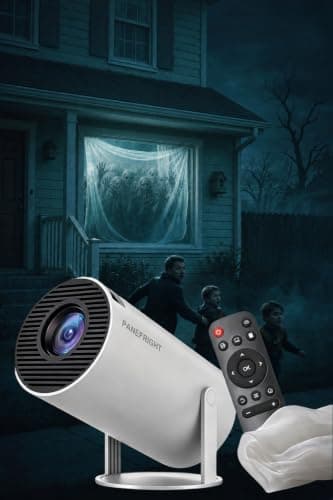
Halloween Window Projector with 40 Scenes
Panefright
The self-contained option: weather-rated housing, scenes on board, stake mount in the box. Check the lumen figure before anything else, because brightness is what fails outdoors.
- Housing
- Outdoor rated
- Content
- Built-in scenes, no media source needed
- Mounting
- Ground stake, usually included
- Key spec
- Brightness, so compare lumens rather than resolution
Good
- Nothing to plug a laptop or USB stick into
- Designed to sit outside for the season
- Stake mount means no bracket engineering
Less good
- Built-in scene libraries are small and you will tire of them
- Brightness in this tier is the limiting factor on anything but a dark street
- Fixed content means no upgrade path
- Illusion quality6.8
- Ease of setup9.4
- Weather exposure7.8
- Content variety5.6
- Value8.4
#ad How we are funded - price as of November 4, 2026
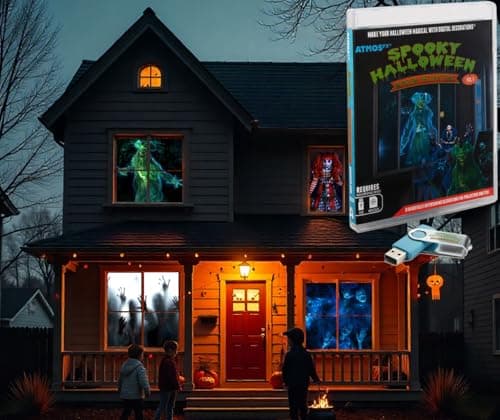
Spooky Halloween Digital Decoration USB, 9 Effects
AtmosFX
Projector, content and screen in one box. Buy it when you have no projector and skip it when you do, because the projector is the part you might already own.
- Projector
- 1280 x 720 mini LED with sound and remote
- Content
- Halloween effects on USB
- Screen
- Translucent rear-projection screen included
- Placement
- About 6 to 8 ft from the window or doorway
Good
- Nothing else to buy or match up
- The included projector is specified for this job rather than for movies
- Remote and onboard sound mean no extra hardware
Less good
- 720p projector is modest if you want to use it for anything else
- Bundle pricing is poor value if you already own a projector
- Brightness limits how much ambient light the scene tolerates
- Illusion quality8.4
- Ease of setup9.2
- Weather exposure9.6
- Content variety8.4
- Value7.4
#ad How we are funded - price as of November 4, 2026
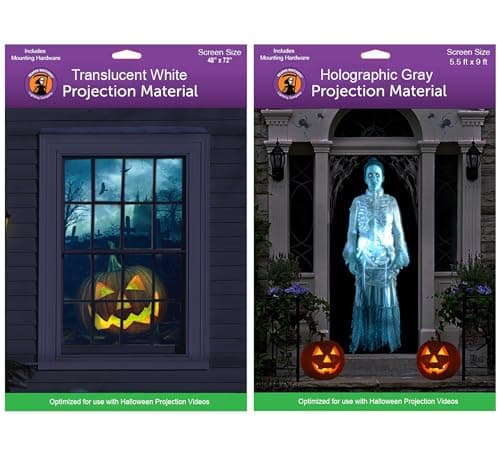
Rear Projection Screen Combo Kit, 48 x 72 in
Reaper Brothers
The single component that separates a convincing window illusion from a bedsheet. Buy the screen even if you improvise everything else.
- Type
- Translucent rear-projection material
- Mounting
- Window or doorway
- Pairs with
- Any projector with the right throw distance
- Reusable
- Yes, across seasons
Good
- Purpose-made diffusion, which is what sells the apparition effect
- Works with any projector rather than locking you to a bundle
- Rolls up small for storage
Less good
- Needs a genuinely dark room behind it
- Creases show on camera if it is stored folded rather than rolled
- Window frames are rarely the size the screen is
- Illusion quality9.0
- Ease of setup7.4
- Weather exposure9.6
- Content variety6.0
- Value8.8
#ad How we are funded - price as of November 4, 2026
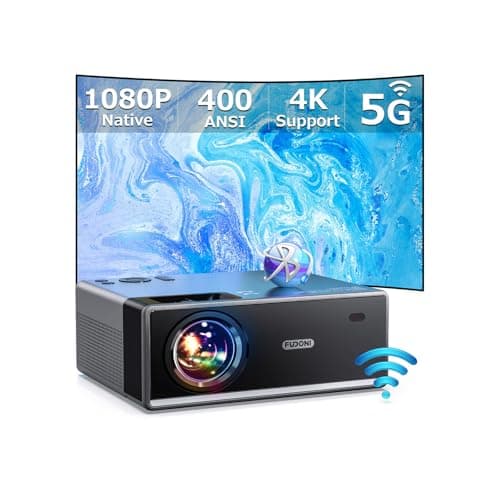
400 ANSI Native 1080p Wi-Fi Projector
FUDONI
Standard throw, high lumens, far less money. It works on a garage door if you have the driveway depth to back it up, and that is the whole decision.
- Resolution
- 1080p native on the better units
- Brightness
- Compare lumens first; it decides everything outdoors
- Throw
- Standard, so it needs distance for a large image
- Placement
- Back of the driveway, aimed at the door
Good
- Far cheaper than a short-throw model of similar brightness
- Plays USB media directly on most units, so no laptop outside
- Doubles as a movie projector, which justifies the spend
Less good
- Needs real throw distance, which small driveways do not have
- Sitting mid-driveway means a cord across the walkway
- Advertised lumen figures at this tier are frequently optimistic
- Image size7.8
- Brightness7.8
- Weather tolerance3.2
- Ease of setup6.8
- Value8.4
#ad How we are funded - price as of November 4, 2026
Front projection and rear projection
There are two ways to use a video projector and they produce different effects. Front projection puts the projector outside, throwing onto a wall, a garage door or a sheet — the viewer and the projector are on the same side, so anyone walking in front casts a shadow. It is the right choice for a big image on a big surface.
Rear projection puts the projector inside the house, throwing onto a translucent screen hung in a window. The viewer sees the image through the screen from the other side. Nothing can walk through the beam, the hardware stays dry and the illusion is much stronger because the figure appears to be inside the room. For a house facing a street, this is usually the better use of one projector. Window projection vs yard projection compares the two in detail.
Why the screen matters more than the projector
The most common upgrade people make is a brighter projector, and the most effective one is usually a better surface. Projecting onto bare window glass gives a dim image with a reflected hot-spot. Projecting onto a dark brick wall loses most of the light into the brick. A proper rear-projection screen in a window, or a light sheet of screen material over a garage door, often doubles the apparent brightness for a fraction of what a brighter projector costs.
The best Halloween projector for a garage door covers the surface problem on the biggest flat area most houses have, and the best Halloween window decorations covers where a projected window sits alongside the simpler options.
Weather, and where the projector actually lives
Halloween-branded outdoor projectors are generally sealed to a basic weather rating and come with a ground stake. General-purpose video projectors are indoor devices and need a weatherproof enclosure if they are going to live outside for six weeks. Either way, the cable run back to an outlet has to be outdoor-rated and routed off the path.
Rear projection sidesteps all of this, which is another reason it is the sensible first setup: the projector sits on a table in a bedroom and nothing outside needs power at all. Halloween decoration power draw covers the load side if the display is growing.
Frequently asked questions
How do Halloween projectors work?
They throw light through a moving image onto a surface. Effect projectors spin a patterned disc or sweep lasers to cover a wall in moving shapes; video projectors play an actual clip, such as a ghost or a face, onto a wall or onto a screen hung in a window.
What is the difference between a Halloween projector and a regular projector?
Halloween-branded ones usually have effects preloaded, a simple remote, a ground stake and a basic weather rating. A regular video projector is brighter and sharper but is an indoor device that needs an enclosure, and you supply the content yourself.
Why is my Halloween projector image so dim?
Almost always ambient light or the surface. A streetlight or porch lamp on the same wall will beat any consumer projector, and dark brick absorbs most of the image. Kill the competing light first, then improve the surface, then consider a brighter unit.
Do you need a screen for a Halloween projector?
For a window, yes — bare glass gives a dim image with a reflected hot-spot. For a wall or a garage door, a light matte surface can be enough, though screen material over a dark or textured door makes a large difference.
Is it better to put the projector inside or outside?
Inside, for most houses. Rear projection onto a screen in a window keeps the hardware dry, stops anyone walking through the beam, and makes the figure look like it is inside the room, which is a stronger illusion than an image on a wall.
About the author
Mike M.
Mike M. is the hands-on owner behind Iron Mako Media, which publishes Haunt & Hedge. The site covers the gear that builds a yard haunt, for the person who already decorates and adds one bigger piece a year.
Every pick here is chosen from manufacturer specifications, manuals, safety standards and verified buyer data. Read how we choose picks.