Planning
Halloween House Decorations, Zone by Zone
The house is the biggest surface you own and most displays never touch it. The thing stopping you is not the decoration, it is the fixing.
Disclosure: we earn a commission from qualifying purchases made through links on this page, at no extra cost to you. It does not change what we recommend — here is how we choose.
The short answer
Decorate the house in six zones: roofline, walls, windows, porch, front door and garage door. Pick the fixing for each surface first — clips on gutters and shingles, no-hole hooks in siding seams, sprung clips on brick — then hang the decoration. Never nail into siding or shingles.
Almost every yard display is built on the lawn. The house behind it stays a blank thirty-foot backdrop, which is strange, because it is the largest single surface on the property and the one that reads from the farthest away. A yard full of props in front of an undecorated house looks like props on a lawn. The same props with the house dressed look like a scene.
The reason people stop at the lawn is not imagination. It is that nobody wants to put a hole in their own siding, and the obvious alternatives — nails, staples, duct tape, the general-purpose adhesive hook rated for indoor drywall — are all genuinely bad ideas on a building exterior. So the facade stays empty. This guide fixes that part first, because once you know what each surface takes, the decorating is the easy half.
Pick the fixing before you pick the decoration
There is no universal outdoor hook. Your house has two or three different surfaces on the front elevation alone, and each one has exactly one no-damage fixing that works. Work out which surfaces you have, buy those few small items once, and you will reuse them every October for a decade.
| Surface | Use this | Never use |
|---|---|---|
| Gutter lip and shingle course | Plastic gutter or shingle light clips | Nails, screws or staples into the roof covering |
| Vinyl or lap siding | No-hole siding hooks rolled into the seam | Anything that punctures a panel |
| Brick with a recessed mortar joint | Sprung steel brick clips | Masonry anchors for a one-month decoration |
| Painted trim, fascia and columns | Outdoor-rated removable hooks, or soft rope ties | Indoor adhesive strips — they fail wet and lift paint |
| Glass | Suction cups and static cling | Tape adhesive, which bakes on in sun |
| Soffit, pergola and porch beam | Screw-in cup hooks you leave in year round | Over-weighting a single point with a heavy prop |
Roof and gutters
Roofing manufacturers are unambiguous about this. CertainTeed and IKO both tell homeowners not to use nails, screws or staples to attach seasonal lighting, because any penetration through the roof covering is a path for water, and a bent piece of flashing or a nail hole does not announce itself until it has been leaking for a season. The published alternative is the same in both cases: plastic clips that hook over the gutter lip or slide under a shingle butt without piercing anything.
The useful detail is that one clip design does both jobs, so you do not have to decide from the ground whether you are working off the gutter or the shingles. Buy one large pack and you will have enough for the full run of a typical house with spares.
Vinyl and lap siding
Siding is a drained, layered system rather than a solid wall, and a hole through a panel defeats it. Beyond the water, there is a warranty question: industry guidance based on the Vinyl Siding Institute's standards treats puncturing or cutting a panel as alteration beyond intended use, which gives a manufacturer grounds to decline a later claim. Screws create a second problem by stopping a panel expanding and contracting with temperature, which is what cracks and buckles it.
The no-hole siding hook sidesteps all of it. It rolls into the horizontal seam where one course laps the next and hangs off the lap itself, so there is no penetration, nothing to caulk, and nothing to find in the spring. It is the single most useful thing in this guide and it costs less than a bag of fun-size candy.
Brick, stone and stucco
On brick, the sprung clip grips the top and bottom of one brick and holds against the mortar recess. It needs two things to be true: your bricks have to fall in the size range the clip is cut for, and the mortar joints have to be recessed rather than flush, so the clip has somewhere to seat. Measure a brick before you buy, because brick height is not standardized everywhere.
Stucco and stone have no equivalent no-damage option. Hang from the soffit, the trim, a porch beam or the gutter above instead, and keep the wall itself for projection — which is free, leaves no mark, and covers more area than anything you can hang. The window projection setup guide covers that.
The hardware that makes the facade usable
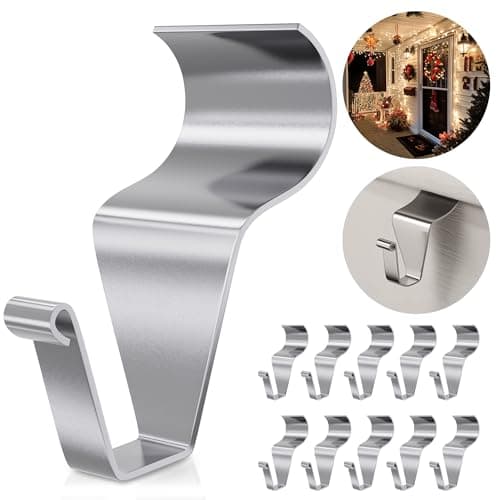
No-Hole Vinyl Siding Hooks, 10 Pcs, Stainless Steel
Amuille
Rolls into the seam between two siding courses and hangs off the lap, so the wall stays unpunctured. If your house is sided, this is the first thing to buy and the cheapest thing on the page.
- Type
- J-shaped hanger that rolls into a siding seam
- Material
- Stainless steel
- Capacity
- 12 lb per hook (manufacturer stated)
- Count
- 20 per pack on this listing
Good
- No hole, so there is nothing for water to get behind later
- Stainless, so it will not rust-streak a light-colored wall
- Reusable season after season — take them out in November and keep the bag
Less good
- Vinyl and some steel lap siding only; useless on stucco, brick or fiber cement
- The stated capacity is per hook in a sound seam, not a license to hang an animatronic
- A hook under tension can bow a soft panel in heat — spread the load over two
- Damage risk9.8
- Build quality8.6
- Setup effort9.4
- Weather tolerance9.0
- Value9.0
#ad How we are funded - price as of November 4, 2026
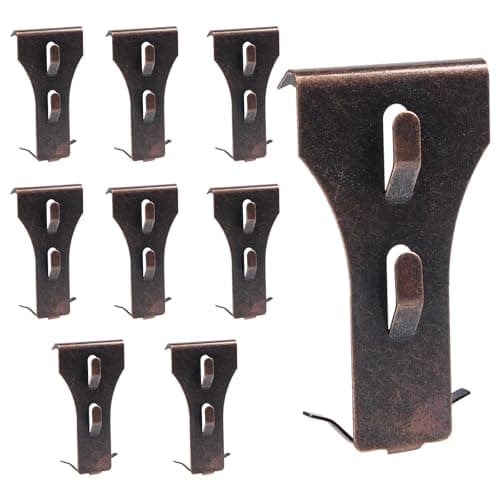
No-Drill Brick Hook Clips, 8 Pcs
Various
A sprung steel clip that grips the top and bottom of one brick. It is the only no-damage option on masonry, and the only one that needs you to measure before you buy.
- Type
- Sprung steel clip, grips a single brick course
- Fits
- Standard brick 2-1/4 to 2-3/8 in tall (listing stated)
- Needs
- A recessed mortar joint for the clip to seat in
- Count
- 24 per pack on this listing
Good
- No drilling, no anchors, no masonry bit, no patching in November
- Steel, and rated well above anything a facade decoration weighs
- Comes off with a squeeze and goes back in the box
Less good
- Brick height is not standardized everywhere — measure yours first or it will not seat
- Flush or over-filled mortar joints give the clip nothing to bite, so it simply will not work
- Will scratch a painted brick face; that matters on a limewashed or painted wall
- Damage risk9.0
- Build quality8.8
- Setup effort8.0
- Weather tolerance8.6
- Value8.4
#ad How we are funded - price as of November 4, 2026
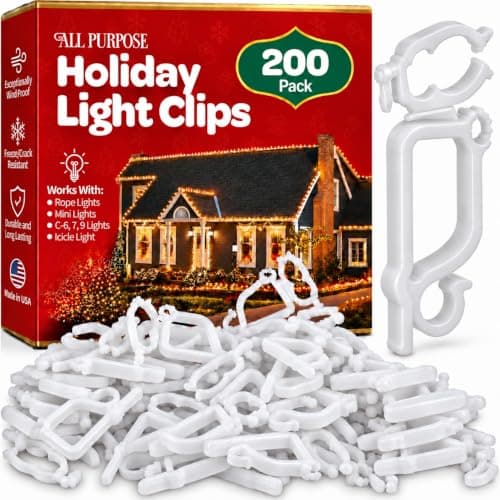
All-Purpose Holiday Light Clips, Set of 200
Various
The clip that ends the argument about how to light a roofline. One shape hooks over a gutter lip or slides under a shingle butt, so a single box covers the whole run of a typical house.
- Type
- Dual-purpose plastic clip, gutter lip or shingle butt
- Count
- Commonly sold in sets of 100, 200 or 400
- Light types
- Mini, C6, C7, C9, rope and icicle (listed)
- Tools
- None — the clip is the fixing
Good
- No nails, screws or staples, so nothing punctures the roof covering
- One clip shape handles both the gutter and the shingle course above it
- Cheap enough to over-buy, and the spares get used again in December
Less good
- Plastic goes brittle in cold; expect to lose some every season
- Shingle mounting means walking or laddering the roof edge, which is the real risk
- Will not grip a gutter guard, a wide fascia or an unusually thick gutter lip
- Damage risk9.6
- Build quality7.0
- Setup effort8.4
- Weather tolerance7.4
- Value9.2
#ad How we are funded - price as of November 4, 2026
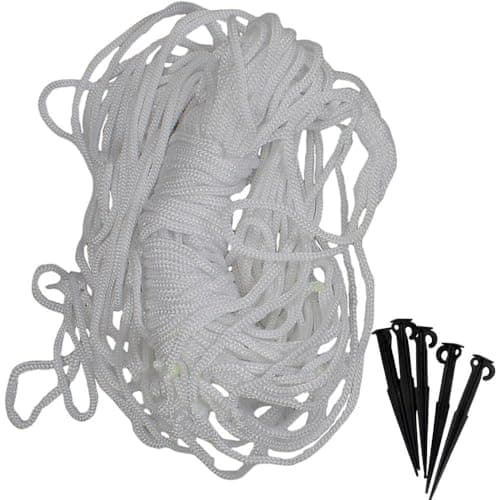
Mega Yard Web, 23 x 18 ft Nylon Web
Various
Roughly 23 by 18 feet of triangular rope web with a gutter bracket at the apex and stakes at the base. Nothing else turns the whole front of a house into one piece for this little effort.
- Size
- About 23.3 x 18.7 ft, triangular
- Material
- Polyester blend rope
- Included
- 1 gutter bracket, 5 ground stakes
- Lighting
- Glows under blacklight (manufacturer stated)
Good
- Scales to the whole facade, which no single prop at this effort level does
- Rope rather than stretch cotton, so it survives rain instead of sagging into string
- The blacklight response gives you a second, completely different look after dark
Less good
- The apex bracket has to go on a gutter, so the top end still means a ladder
- A 23-foot web is a sail — it loads the gutter and the stakes in a real wind
- Stock rotates hard in October; the exact pack is not always on one retailer
- Street presence8.8
- Build quality7.6
- Weather tolerance7.2
- Setup effort6.4
- Storage footprint8.8
#ad How we are funded - price as of November 4, 2026
The six zones, and what belongs in each
Work the house top to bottom. It keeps the ladder work in one session and stops you hanging something at head height that you then have to take down to reach past.
1. The roofline
The roofline is the outline of the house, and lighting it is what makes the building read as part of the display rather than the thing behind it. Orange or purple along the gutter run does more for a facade than any single prop, because it describes the shape of the house from down the street.
This is also where a roof inflatable or a pair of oversized eyes in the gable goes. Both read from a long distance and neither competes with anything on the lawn. Roof inflatables covers what is actually designed to sit up there, as opposed to what is merely tall.
2. The walls
The wall is your one genuinely large surface, so put something large on it. A giant rope web spanning the facade, a swarm of oversized bats climbing toward the eaves, or a projection across the whole elevation — those three are the only things that fill a wall. A single wreath-sized item on a two-story facade disappears.
Scale is the whole trick here. Whatever you would use indoors, go up two sizes. A 24-inch spider is a toy on a house wall and a presence on a porch column, and the same is true of nearly everything else.
3. The windows
Windows are the only part of the house that can be lit from inside, which makes them the cheapest effect on the building. A silhouette on the glass with a colored lamp behind it reads from the street all evening and costs almost nothing, and rear projection onto a sheet of thin fabric turns one window into a moving figure.
Keep the fixings on the glass, not the frame — suction cups and static cling come off clean, and tape left on a painted sash in October sun does not. Upper-floor windows are worth more than ground-floor ones because they sit above every parked car and hedge on the street.
4. The porch and columns
The porch is where trick-or-treaters actually stand, so it is the one zone that gets looked at closely. It rewards detail that would be wasted on the lawn: cloth wrapped up a column, a lantern with a flicker bulb, something small and specific on the floor by the step.
Columns and porch beams are also the best hanging points on the entire house. They are structural, they are already at the right height, and a cup hook screwed into the underside of a beam is invisible and permanent, so next year it takes thirty seconds.
5. The front door
A front door is roughly twenty square feet of flat surface at eye level, and it is the last thing anyone sees before you open it. A full-door cover uses all of it. Anything smaller than the door leaves the door looking like a door with a decoration on it.
Whatever goes on the door has to tolerate being opened two hundred times in an evening, which rules out anything hanging loose at the hinge side and anything that blocks the view out through the glass.
6. The garage door
The garage door is the largest unbroken rectangle on most American houses and almost nobody uses it. It is a projection screen that came with the property. The garage door projector guide covers throw distance and the brightness you actually need for a surface that size.
If you are not projecting, cover it instead. A printed door banner or a web stretched corner to corner is the only other thing with the scale to take it on, and either beats leaving a twenty-foot blank panel in the middle of the display.
Light the house, do not just decorate it
Everything above happens in daylight and gets judged after dark. A facade with decorations and no lighting plan is a dark wall with shapes on it, and that is the single most common way a house display disappoints the person who built it.
Two fixtures do most of the work. An uplight at the base of the wall, aimed up, throws the facade into relief and exaggerates the height of the building. A second light in a different color on the porch or the door separates the entrance from the wall behind it, so the eye knows where to go. The lighting color guide covers which colors hold up outdoors, and outdoor Halloween lights covers the fixtures.
Leave parts of the house dark on purpose. Contrast is what makes anything read at night, and a facade lit evenly all over reads as flat as an unlit one.
Power, weather and the parts people forget
- Run power before you hang anything. Work out which exterior outlet feeds what, and how much that circuit can take, before the props are up and the cords are a problem. The power hub covers circuit load and GFCI.
- Everything outside needs a GFCI outlet, and every cord joint needs to be off the ground and shielded from rain. A connection sitting in a gutter splash line is the one that trips the circuit mid-evening.
- Wind loads at height are far higher than at ground level. A big web, a banner or a roof inflatable is a sail, and the fixing has to hold the gust rather than the weight. Weatherproofing decorations covers the rest.
- Check what the fixing is attached to. An old gutter, a loose fascia board or a soft siding panel will fail before the hook does.
- Take it all down in November. Clips go brittle, hooks stain trim if they are not stainless, and anything left up over the winter is what eventually causes damage.
The order to do it in
- Walk to the sidewalk in daylight and photograph the front of the house. You will plan against the photo far better than against the building.
- Identify your surfaces. Shingle or gutter, siding or brick, how much painted trim. Buy the fixings that match, once.
- Sort power. Which outlet, which circuit, where the cords run and where they cross the path.
- Do the roofline first, while the ladder is out and you are fresh. Lights, then anything in the gable.
- Then the wall, because it is the biggest piece and everything else is placed relative to it.
- Windows, porch, door and garage last — all reachable from the ground, all quick, all the detail work.
- Check it at night, from the sidewalk. Then fix the lighting, which is what will be wrong.
Once the house is dressed, the lawn becomes the foreground of a scene instead of the whole display. Yard layout covers arranging what stands in front of it, and the best outdoor Halloween decorations covers one pick from every category in the order a display is worth building.
The facade pieces worth adding next
Once the fixings are sorted, the biggest single change to a facade is a rope web — how to hang a Halloween spider web outside covers the apex-first sequence and the no-hole fittings for siding and brick, and the best Halloween spider decorations covers what goes on it. For an entry rather than a wall, witch decorations suit a covered porch better than anything that needs a lawn.
Frequently asked questions
How do you decorate the outside of a house for Halloween?
Work in six zones — roofline, walls, windows, porch, front door and garage door — and choose the fixing for each surface before the decoration. Light the roofline, put one large piece on the wall, light the windows from inside, and keep the detail work for the porch.
How do you hang Halloween decorations without damaging siding?
Use no-hole siding hooks that roll into the seam between two courses and hang off the lap. Never nail or screw through a panel: it breaks the drainage plane, it can void the siding warranty, and a screw stops the panel expanding and contracting.
Can you hang Halloween decorations on brick?
Yes, with sprung steel brick clips that grip one brick. They need bricks in the standard 2-1/4 to 2-3/8 inch height range and recessed mortar joints to seat in, so measure first. Flush mortar gives the clip nothing to hold.
Is it safe to put Halloween lights on the roof?
Only with clips, never with nails or staples — roofing manufacturers warn that any penetration through the roof covering can leak. Use gutter or shingle clips, and treat the ladder rather than the lights as the real hazard.
What is the biggest mistake with Halloween house decorations?
Using indoor-sized decorations on an outdoor-sized surface. A facade needs one large piece, not six small ones. The second biggest is hanging everything in daylight and never checking how it reads from the street after dark.
Sources
- CertainTeed — the dos and don'ts of hanging holiday lights
- IKO — how to hang lights on a shingle roof
- Pacific Exteriors — why a siding warranty could be void
- SEWANTA all-purpose gutter and shingle light clips listing
- Amuille no-hole vinyl siding hooks listing
- Brick hook clips listing, standard brick 2-1/4 to 2-3/8 in
- Fun World Mega Yard Web 23 ft x 18 ft, The Home Depot
About the author
Mike M.
Mike M. is the hands-on owner behind Iron Mako Media, which publishes Haunt & Hedge. The site covers the gear that builds a yard haunt, for the person who already decorates and adds one bigger piece a year.
Every pick here is chosen from manufacturer specifications, manuals, safety standards and verified buyer data. Read how we choose picks.