Lighting & Projection
Window Projection vs Yard Projection
One is limited by your wall. The other is limited by your room. Check which before you buy anything.
Disclosure: we earn a commission from qualifying purchases made through links on this page, at no extra cost to you. It does not change what we recommend — here is how we choose.
The short answer
Window projection puts the projector inside, aimed at a translucent screen in a window, with a darkened room behind. Yard projection puts it outside aimed at the house. Window projection looks better and never risks the hardware; yard projection is bigger and needs a light, flat, matte wall to work at all.
This is the first decision in projection and people usually make it by accident, based on which product they happened to find. It is worth making deliberately, because your house has probably already decided it for you.
Side by side
| Window projection | Yard projection | |
|---|---|---|
| Projector location | Inside, dry and safe | Outside, exposed |
| Surface | A translucent screen you supply | Your house wall |
| Works on brick or texture? | Yes — the screen is the surface | No |
| Scale | Window sized | As big as the wall |
| Illusion quality | High — diffused, reads as present | Moderate — reads as a projection |
| Ambient light tolerance | Needs a dark room behind | Needs a dark yard in front |
| Weather risk | None | Lens fogging, vent moisture |
| Setup | Mount a screen, darken a room | Stake, aim, weatherproof |
What each setup needs
Spooky Halloween Hollusion USB with Projection Screen
AtmosFX
The content and the screen together, which is the pairing that actually makes window projection look like an apparition instead of a movie playing on a curtain.
- Contents
- Halloween effects on USB plus a rear-projection screen
- Screen size
- About 5.5 ft by 9 ft
- Needs
- A projector with USB playback
- Placement
- Projector roughly 6 to 8 ft from the window
Good
- Purpose-made translucent screen, which is the part people improvise badly
- Content designed for the illusion rather than generic video
- Works from inside the house, so nothing is weather exposed
Less good
- You still need a projector with USB playback
- Needs a dark room behind the screen to work
- Screen mounting in a window frame is fiddlier than it sounds
- Illusion quality9.2
- Ease of setup7.0
- Weather exposure9.6
- Content variety8.4
- Value7.6
Translucent Rear Projection Screen
Reaper Brothers
The single component that separates a convincing window illusion from a bedsheet. Buy the screen even if you improvise everything else.
- Type
- Translucent rear-projection material
- Mounting
- Window or doorway
- Pairs with
- Any projector with the right throw distance
- Reusable
- Yes, across seasons
Good
- Purpose-made diffusion, which is what sells the apparition effect
- Works with any projector rather than locking you to a bundle
- Rolls up small for storage
Less good
- Needs a genuinely dark room behind it
- Creases show on camera if it is stored folded rather than rolled
- Window frames are rarely the size the screen is
- Illusion quality9.0
- Ease of setup7.4
- Weather exposure9.6
- Content variety6.0
- Value8.8
Outdoor Halloween Projector with Built-In Scenes
Various
The self-contained option: weather-rated housing, scenes on board, stake mount in the box. Check the lumen figure before anything else, because brightness is what fails outdoors.
- Housing
- Outdoor rated
- Content
- Built-in scenes, no media source needed
- Mounting
- Ground stake, usually included
- Key spec
- Brightness, so compare lumens rather than resolution
Good
- Nothing to plug a laptop or USB stick into
- Designed to sit outside for the season
- Stake mount means no bracket engineering
Less good
- Built-in scene libraries are small and you will tire of them
- Brightness in this tier is the limiting factor on anything but a dark street
- Fixed content means no upgrade path
- Illusion quality6.8
- Ease of setup9.4
- Weather exposure7.8
- Content variety5.6
- Value8.4
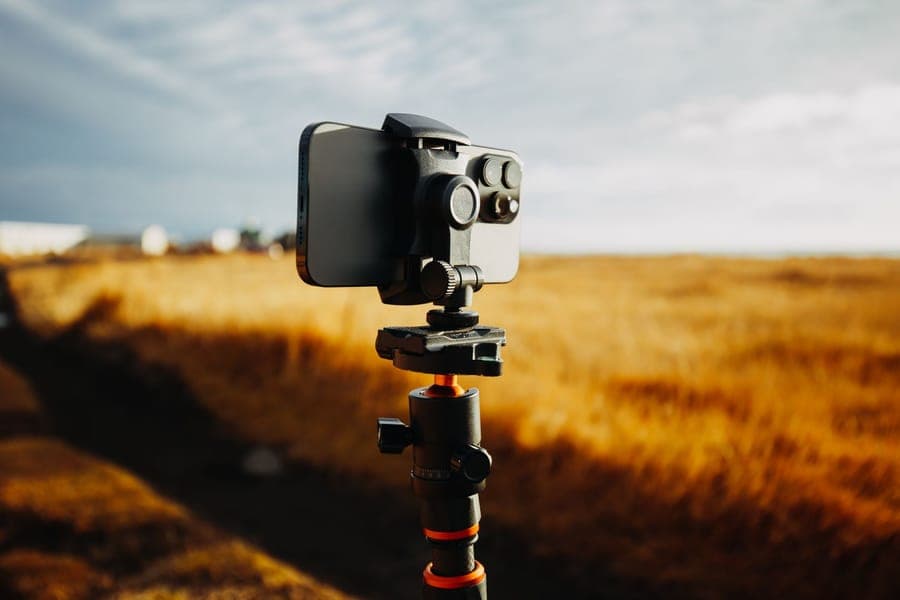
Outdoor Projector Ground Stake Mount
Various
A projector resting on an upturned bucket will move, and a moved projector is a keystoned mess. A staked, adjustable mount is a small purchase that protects a big one.
- Type
- Adjustable ground-stake mount
- Thread
- Commonly a standard tripod thread, so verify
- Adjustment
- Tilt and rotate
- Ground
- Soil or turf
Good
- Holds the angle you set instead of drifting overnight
- Standard tripod threads fit most small projectors
- Gets the projector out of the mud
Less good
- No use on concrete or decking
- Cheap ball joints creep under weight
- Still needs a weather plan for the projector itself
- Stability8.2
- Adjustability8.4
- Weather tolerance7.4
- Setup effort8.8
- Value8.8
Check your wall first
Yard projection is entirely dependent on the surface, and the fix for a bad surface is never a brighter projector. Stand outside at night and shine a bright flashlight at the wall:
- Light, flat, matte — pale siding, smooth stucco, painted board. Yard projection will work well.
- Light but textured — the image will be broken up by relief. Marginal, and worse on faces.
- Dark brick or dark paint — the wall absorbs the image. Yard projection will not work, whatever you spend.
- Glossy — specular reflections will blow out sections of the image. Poor.
- Interrupted by windows, pipes or vents — the image lands on all of it. Choose a cleaner section or accept the interruptions.
If your wall fails that test, window projection is not the compromise — it is the option that works. A lot of brick-fronted houses spend money twice discovering this.
Check your room second
Window projection has its own requirement: the room behind the screen must be genuinely dark. Any light in it washes out the image from the street side, and a room with an open door to a lit hallway is not dark.
You also need throw distance inside the room — typically around six to eight feet back from the window for a standard kit — and somewhere stable to put the projector. In a small room that can be genuinely tight, and a short-throw projector is the answer if it is.
Verdict by use case
Best illusion
Window projection, clearly. The translucent screen diffuses the image so the figure reads as occupying the room rather than as video on a surface. That is the effect people film, and it is why the screen is the component worth buying even if you improvise everything else.
Biggest visual impact from the street
Yard projection, when the wall allows it. A whole-facade image is visible from much further away than a window, and scale carries at distance where detail does not.
Lowest risk to the hardware
Window projection, by a wide margin. The projector never leaves the house, which removes lens fogging, vent moisture and theft from the equation in one move.
Textured or dark house
Window projection, or a laser pattern projector if you want the facade covered. Lasers throw pattern rather than picture and are unbothered by texture — projector lights covers that route.
Doing both
They layer well, and this is how the best-looking houses do it: a pattern or color wash across the facade for the base layer, and a window projection as the detail that rewards people who come closer. The facade pulls people in from the street; the window is what they stand and look at.
If you are doing that, keep the facade lighting off the window — a flood washing across a projection screen destroys it. The window projection setup guide covers the build.
Frequently asked questions
Is window projection better than projecting on the house?
The illusion is better, because a translucent screen diffuses the image so a figure reads as present rather than as video on a surface. Facade projection is bigger and carries further, but only if your wall is light, flat and matte.
Can you project onto a house with brick?
Not well. Dark brick absorbs the image and texture breaks it up, and a brighter projector does not fix either. Use window projection or a laser pattern projector, which works on texture.
How far back does a projector need to be for window projection?
Typically six to eight feet from the window for a standard kit, though it depends on the throw ratio. In a small room a short-throw projector is the answer.
Do I need to close the curtains for window projection?
You need the room behind the screen genuinely dark, which usually means closing the door to lit spaces as well. Any light in that room washes out the image when viewed from the street.
About the author
Mike M.
Mike M. is the hands-on owner behind Iron Mako Media, which publishes Haunt & Hedge. The site covers the gear that builds a yard haunt, for the person who already decorates and adds one bigger piece a year.
We do not run a test lab and we do not claim to have physically tested products we have not. Read how we choose picks.