Fog & Atmosphere
What Size Fog Machine Do I Need?
Wattage is how fast it heats. CFM is how much it moves. Neither is the number that decides whether your yard looks right.

Disclosure: we earn a commission from qualifying purchases made through links on this page, at no extra cost to you. It does not change what we recommend — here is how we choose.
The short answer
For a porch or a small entry, a 400 to 700 watt fogger is plenty. For a typical front yard, 1000 watts is the right default. For a large open property you want a high-output machine rated in the region of 20,000 CFM. Going bigger than your space needs is the most common mistake in this category: an oversized machine fogs out the street, empties its tank and looks like nothing by nine o'clock.
Fog machines are sold on two numbers and neither one answers the question people are actually asking. Wattage describes the heater, which determines how fast the machine warms up and how quickly it recovers between bursts. CFM describes output volume. The number that decides whether your display looks good is neither — it is whether the fog is cold, and that is a separate purchase decision entirely.
Size by the space, not by the spec sheet
| Space | Rough size | What you are aiming for |
|---|---|---|
| Indoor room or garage party | 400 to 700 W | Enough haze to catch a light beam |
| Porch or small entry | 400 to 700 W | Localised atmosphere at the door |
| Graveyard or one scene | Chilled machine, any wattage | Ground creep, not volume |
| Typical front yard | About 1000 W | Visible haze across the display |
| Large open yard | High output, ~20,000 CFM | Whole-space fill in about a minute |
| You already own a fogger | Add a chiller | Low fog without a new machine |
Two rows deserve calling out. The graveyard row has no wattage in it on purpose: for ground creep, output volume is close to irrelevant and chilling is everything. And the last row is the one most readers should act on — if there is already a working fogger in the garage, a chiller converts it rather than replacing it, and that is almost always the cheaper path to the effect people are after.
Bigger is worse more often than it is better
An oversized machine in a small space fails in four ways at once, and none of them show up in a product listing:
- It stops reading as fog. Past a certain density the effect is flat whiteout, which hides the props you spent the money on.
- It fogs the street. Neighbors, drivers and the people walking up your path all lose visibility, which is a genuine problem rather than an aesthetic one.
- It empties the tank. High output run continuously gets through fluid startlingly fast, and the machine is dry before the busiest hour.
- It trips things. A big heater is one of the highest continuous draws in a display — see Halloween decoration power draw.
The correct mental model is that a fog machine is a seasoning, not an ingredient. You want enough to make light visible and to soften outlines, and the moment somebody says the word fog instead of the word spooky, there is too much of it.
Machines that fit each size band
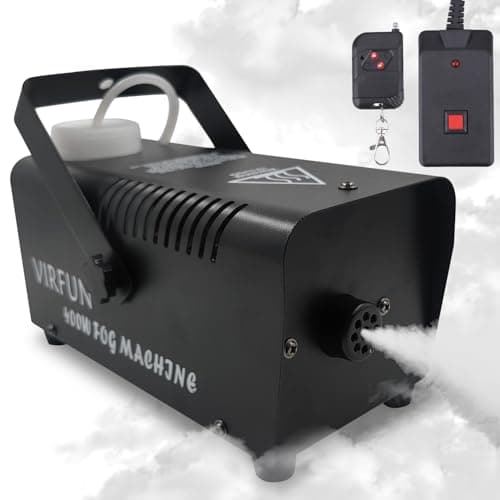
Fog Machine with Wireless Remote Control
VIRFUN
A room-sized fogger rather than a yard machine, which is the distinction that matters indoors — enough haze to catch a light, not enough to empty the house.
- Type
- Compact party fog machine
- Fluid
- Water-based fog juice
- Control
- Wireless remote
- Use
- Indoor room, party or covered space
Good
- Sized for a room rather than a yard, which is the whole point indoors
- Water-based output is the least likely to leave a smell behind
- Wireless remote, so you can fog from across the room
Less good
- Not enough output to do anything useful in an open yard
- Still enough fog to set off an optical smoke alarm in a small room
- No published duty cycle, so plan on it pausing to reheat
- Output7.0
- Indoor suitability8.8
- Build quality7.2
- Setup effort8.8
- Value8.4
#ad How we are funded - price as of November 4, 2026
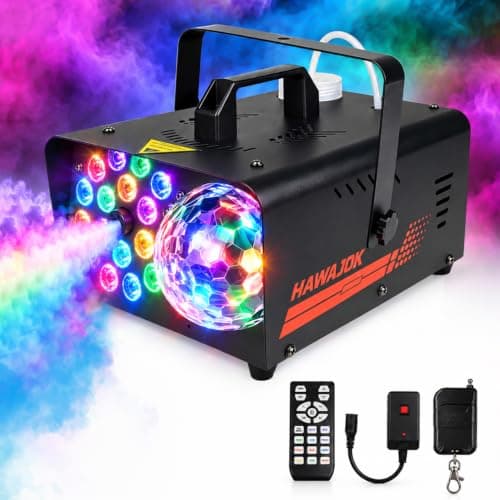
1000W Fog Machine with Wireless Remote and LED Effects
HAWAJOK
Fine as a first machine, and honest about what it is: a heated fogger whose output rises unless you chill it or run it into a cold night.
- Type
- Heated fog machine
- Control
- Wired and wireless remote on most units
- Fluid
- Water-based fog fluid
- Duty cycle
- Short bursts with reheat pauses
Good
- Cheap entry into fog without committing to a chilled setup
- Remote included on almost every unit in this tier
- Enough output for a porch or a small front yard
Less good
- Fog rises unless chilled
- Short duty cycle, so it will be reheating when you want it running
- Seasonal-tier build, and a couple of years is realistic
- Fog density7.0
- Stays low3.6
- Run time5.6
- Setup effort9.2
- Consumable cost8.0
#ad How we are funded - price as of November 4, 2026
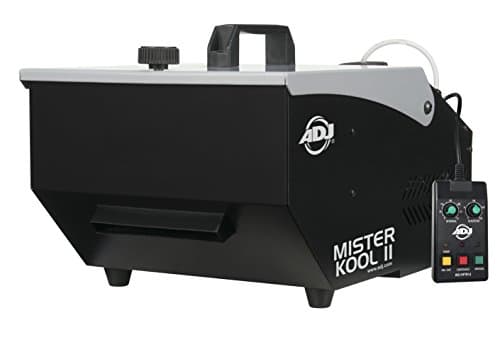
Mister Kool II Low-Lying Fog Machine
ADJ
Makes genuinely low-lying fog from regular ice and water-based fluid, with no dry ice and no CO2 tank, which is why it is the default recommendation for a home yard haunt.
- Cooling
- Regular ice
- Fluid
- Water-based fog juice
- Heat-up
- About 3 minutes
- Consumables
- Ice and fluid, no dry ice
Good
- Ice cooling means no dry-ice sourcing problem on October 31
- Short heat-up, so it is ready when the first visitors arrive
- Fog genuinely hugs the ground rather than rising
Less good
- You are buying and melting ice all evening
- Output is modest next to a dry-ice machine
- Needs a level spot, because a tilted unit dumps meltwater
- Fog density7.8
- Stays low9.0
- Run time7.0
- Setup effort8.4
- Consumable cost7.2
#ad How we are funded - price as of November 4, 2026
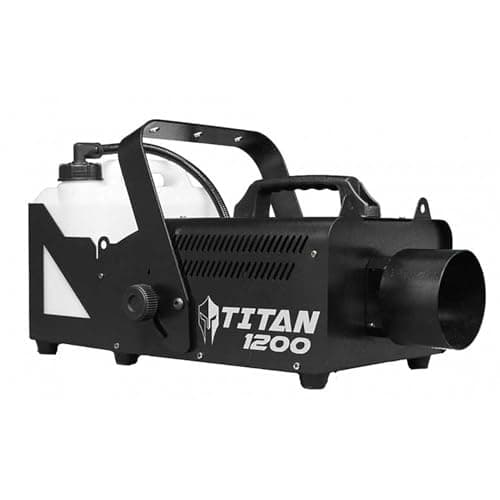
Titan 1200 Fog Machine
Froggy's Fog
Rated at 20,000 CFM, which is enough to fill roughly 2,500 square feet in about a minute. This is the machine for a whole-yard haze, not for a low graveyard creep.
- Output
- 20,000 CFM
- Coverage
- About 2,500 sq ft in roughly a minute
- Type
- Standard heated fogger
- Fluid
- Water-based fog fluid
Good
- Output that genuinely fills a large open yard
- Fast enough to re-fog between groups of visitors
- Built for haunt duty rather than a one-night party
Less good
- Heated fog rises, so this is not a low-lying machine on its own
- Serious output means serious fluid consumption
- Overkill for a small front yard, where it just looks like smoke
- Fog density9.4
- Stays low4.5
- Run time8.0
- Setup effort8.0
- Consumable cost6.0
#ad How we are funded - price as of November 4, 2026
What wattage actually buys you
Wattage is the heater, and the practical consequence is duty cycle. A low-wattage machine heats a small block, fires a short burst, then pauses to recover. A higher-wattage machine recovers faster and can fire more often. That matters enormously on Halloween night, when visitors arrive in clusters rather than at a steady rate.
So the question is not how much fog you want in total, it is how often you need a burst. A 400 W machine triggered every two minutes for four hours will frustrate you. The same machine fired three times when a group walks up, with gaps in between, is completely adequate — and it will outlast a bigger machine running flat out, on both fluid and goodwill.
Run it in bursts, whatever size you buy
This single habit does more for the look of a display than any size upgrade. Continuous running uses fluid at the maximum rate, saturates the space, and removes the contrast that made the fog visible in the first place. Timed bursts put fog where people are, when they are there, and the gaps let the previous burst thin out to the point where light can cut through it.
A machine with a built-in timer or remote makes this realistic — fog machines with a timer covers the models that have the function. A mains timer or smart plug does not do this job, because cutting power to a fog machine does not stop fog, it just leaves a hot heater block with no control over it.
The number nobody prints: wind tolerance
No machine at any size produces fog that survives a breeze. A 5 mph wind clears a yard of ground fog in under a minute, and buying a bigger machine to fight it is the single most expensive mistake in this category. The fixes are free: fog from upwind, use the house, a fence or a hedge as a windbreak, and time the bursts to arrivals rather than running continuously into moving air.
Where to put a fog machine is the practical version of all of that, and how to make fog stay low covers the temperature side. If you want the full hardware comparison, the best Halloween fog machines ranks them by yard rather than by spec.
Before you buy, check what you already have
Three questions in order. Is there a working fogger in the garage? If yes, the next purchase is a chiller, not a machine. Do you want creeping ground fog or visible haze? If creeping, buy chilled and ignore wattage. Is the space indoors or a porch? If so, buy small — a room-sized fogger is a different product from a yard machine, and the yard machine will empty a living room in thirty seconds. Low-lying versus standard fog machines sorts out the first two, and which fog fluid to buy covers the consumable once the machine is chosen.
Frequently asked questions
What size fog machine do I need for a front yard?
About 1000 watts is the right default for a typical front yard. That gives enough output to put visible haze across a display and recovers quickly enough to fire bursts as groups arrive, without fogging out the street the way a high-output machine will.
Is a 1000W fog machine too much for a small space?
For an indoor room or a porch, yes. A 400 to 700 watt machine is the right size there — enough haze to catch a light beam without filling the space in thirty seconds. Yard machines and room machines are genuinely different products.
Does a bigger fog machine make fog stay lower?
No. Output volume and fog height are unrelated. Fog rises because it leaves the nozzle hot, so the only things that lower it are chilling the output with ice, dry ice, or a chiller fitted between the machine and the yard.
What does CFM mean on a fog machine?
Cubic feet per minute — how much fog the machine moves. A machine rated around 20,000 CFM can fill roughly 2,500 square feet in about a minute. It is the right number for whole-yard haze and almost irrelevant if what you want is a low graveyard creep.
How long will a fog machine run before it needs refilling?
It depends entirely on output and duty cycle, and a high-output machine run continuously gets through fluid fast enough to be dry before the busiest hour. Running in timed bursts rather than continuously is the single biggest saving, and it looks better too.
About the author
Mike M.
Mike M. is the hands-on owner behind Iron Mako Media, which publishes Haunt & Hedge. The site covers the gear that builds a yard haunt, for the person who already decorates and adds one bigger piece a year.
Every pick here is chosen from manufacturer specifications, manuals, safety standards and verified buyer data. Read how we choose picks.