Power, Timers & Setup
How to Hang Halloween Decorations Without Damaging Walls
Every surface on a house has a fixing that holds weight and leaves nothing behind. Almost none of them is a nail.

Disclosure: we earn a commission from qualifying purchases made through links on this page, at no extra cost to you. It does not change what we recommend — here is how we choose.
The short answer
Match the fixing to the surface: no-hole siding hooks that slide into the lap of vinyl siding, spring-clip brick hooks that grip the edge of a brick course, shingle and gutter clips for a roofline, and adhesive hooks or hanging strips indoors. Every one of these holds real weight and leaves no hole. Nails, screws and duct tape are the three things that cause the damage people are asking about.
This question comes up because the consequences are expensive and delayed. A screw in vinyl siding creates a hole that lets water behind the panel, and you find out about it in February. Adhesive hooks left on painted interior walls through a warm month pull paint when removed. Both are avoidable with the right fixing, and the right fixing is usually cheaper than the wrong one.
The fixing for each surface
| Surface | Use | Avoid |
|---|---|---|
| Vinyl or aluminum siding | No-hole siding hooks slid into the lap | Screws and nails — they let water behind the panel |
| Brick | Spring-clip brick hooks on the mortar line edge | Masonry anchors for a seasonal prop |
| Stucco | Adhesive hooks on a smooth patch, or a clip to a nearby fixture | Drilling; stucco cracks outward from the hole |
| Gutter and fascia | Gutter clips, light props only | Screws into a gutter; it is not load bearing |
| Roof shingles | Shingle clips under the tab | Anything that lifts or pierces a shingle |
| Interior painted wall | Adhesive strips rated above the prop weight | Pins and nails in rented walls |
| Trees | Soft rope or wide webbing over the branch | Wire and cable ties; they cut into bark |
Siding is the one that actually matters
Of everything on that table, siding is where the real damage happens, because the failure is invisible. Vinyl and aluminum siding panels hang from a nailing strip and overlap, and the overlap is a deliberate drainage path. A screw through the face of a panel puts a hole in the middle of that path, and water that gets behind siding does not come back out.
No-hole siding hooks are shaped to slide up under the lower edge of a panel and hook over the top of the one below. They carry a few pounds each, they go in without a tool, and they come out in October leaving nothing. For anything heavier than a few pounds, do not hang it on siding at all — put it on a stand on the ground or on a porch post.
The fixings worth owning
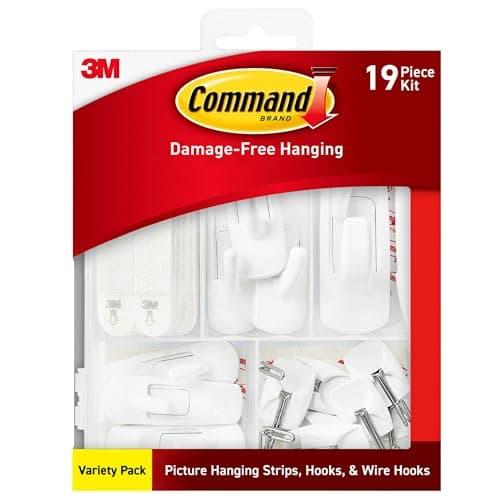
Variety Pack: Hanging Strips, Wire Hooks and Utility Hooks
Command
The least interesting thing on this page and the one that decides whether you get your deposit back. Buy the rated weight above what you are hanging, not at it.
- Type
- Removable adhesive hooks and mounting strips
- Ratings
- Sold by held weight, roughly 0.5 to 7.5 lb
- Surfaces
- Painted drywall, tile, metal, finished wood
- Removal
- Stretch the tab straight down, never pull out
Good
- Designed to release cleanly, which no general-purpose tape does
- Works on the office partitions and rental walls that ban nails
- Cheap enough to over-buy, and you will use the spares all year
Less good
- Fails on textured, dusty or freshly painted surfaces — wait a full cure
- Over-loading is the usual cause of the paint tear people blame on the hook
- Single-use: the strips are not reusable once removed
- Visual impact3.0
- Build quality8.4
- Damage risk9.6
- Setup effort9.4
- Storage footprint9.8
#ad How we are funded - price as of November 4, 2026
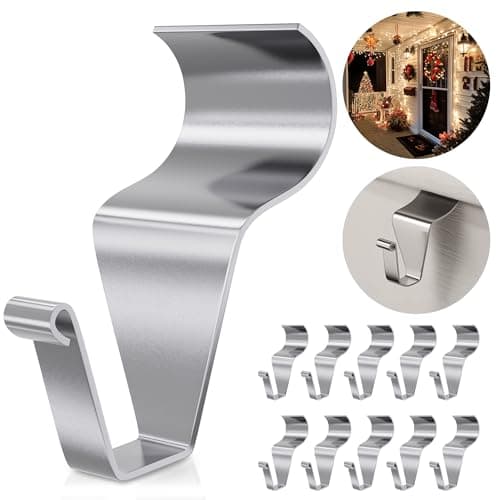
No-Hole Vinyl Siding Hooks, 10 Pcs, Stainless Steel
Amuille
Rolls into the seam between two siding courses and hangs off the lap, so the wall stays unpunctured. If your house is sided, this is the first thing to buy and the cheapest thing on the page.
- Type
- J-shaped hanger that rolls into a siding seam
- Material
- Stainless steel
- Capacity
- 12 lb per hook (manufacturer stated)
- Count
- 20 per pack on this listing
Good
- No hole, so there is nothing for water to get behind later
- Stainless, so it will not rust-streak a light-colored wall
- Reusable season after season — take them out in November and keep the bag
Less good
- Vinyl and some steel lap siding only; useless on stucco, brick or fiber cement
- The stated capacity is per hook in a sound seam, not a license to hang an animatronic
- A hook under tension can bow a soft panel in heat — spread the load over two
- Damage risk9.8
- Build quality8.6
- Setup effort9.4
- Weather tolerance9.0
- Value9.0
#ad How we are funded - price as of November 4, 2026
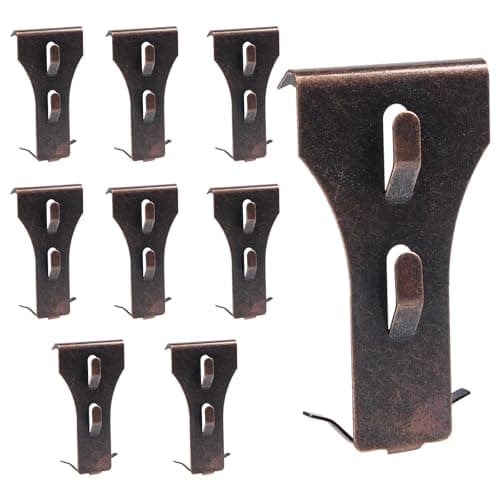
No-Drill Brick Hook Clips, 8 Pcs
Various
A sprung steel clip that grips the top and bottom of one brick. It is the only no-damage option on masonry, and the only one that needs you to measure before you buy.
- Type
- Sprung steel clip, grips a single brick course
- Fits
- Standard brick 2-1/4 to 2-3/8 in tall (listing stated)
- Needs
- A recessed mortar joint for the clip to seat in
- Count
- 24 per pack on this listing
Good
- No drilling, no anchors, no masonry bit, no patching in November
- Steel, and rated well above anything a facade decoration weighs
- Comes off with a squeeze and goes back in the box
Less good
- Brick height is not standardized everywhere — measure yours first or it will not seat
- Flush or over-filled mortar joints give the clip nothing to bite, so it simply will not work
- Will scratch a painted brick face; that matters on a limewashed or painted wall
- Damage risk9.0
- Build quality8.8
- Setup effort8.0
- Weather tolerance8.6
- Value8.4
#ad How we are funded - price as of November 4, 2026
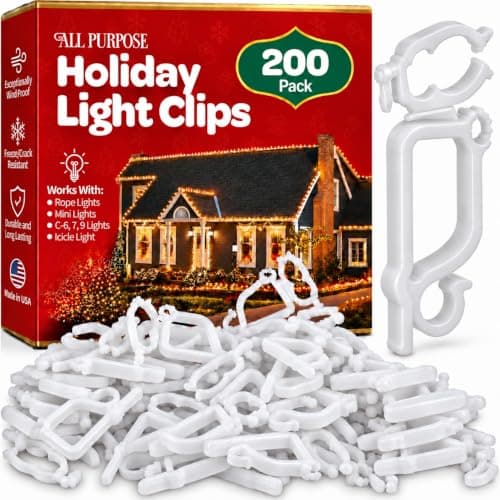
All-Purpose Holiday Light Clips, Set of 200
Various
The clip that ends the argument about how to light a roofline. One shape hooks over a gutter lip or slides under a shingle butt, so a single box covers the whole run of a typical house.
- Type
- Dual-purpose plastic clip, gutter lip or shingle butt
- Count
- Commonly sold in sets of 100, 200 or 400
- Light types
- Mini, C6, C7, C9, rope and icicle (listed)
- Tools
- None — the clip is the fixing
Good
- No nails, screws or staples, so nothing punctures the roof covering
- One clip shape handles both the gutter and the shingle course above it
- Cheap enough to over-buy, and the spares get used again in December
Less good
- Plastic goes brittle in cold; expect to lose some every season
- Shingle mounting means walking or laddering the roof edge, which is the real risk
- Will not grip a gutter guard, a wide fascia or an unusually thick gutter lip
- Damage risk9.6
- Build quality7.0
- Setup effort8.4
- Weather tolerance7.4
- Value9.2
#ad How we are funded - price as of November 4, 2026
Brick, and the mortar question
Spring-clip brick hooks grip the top and bottom edge of a brick course and hold by tension. They are genuinely strong for what they are, they install in seconds, and they leave no mark. The one requirement is a reasonably standard brick with a visible mortar line — they will not work on flush-pointed or irregular stonework.
If you are going to drill brick for something permanent, drill the mortar rather than the brick itself, because mortar is repairable and brick is not. For a seasonal prop, though, there is no reason to drill at all.
Adhesive hooks and the two rules that make them work
Adhesive hanging strips are excellent indoors and fail in two predictable ways, both of which are user error rather than product error.
- Clean the surface with isopropyl alcohol, not a household cleaner. Residue from a surface spray is the single most common reason a hook lets go overnight.
- Wait an hour before loading it. The adhesive needs time to bond, and the instruction that says this is the one everybody ignores.
- Overrate the hook. A strip rated for three pounds holding a two-pound prop will outlast a strip rated for two holding the same thing.
- Remove by pulling the tab straight down the wall, slowly, parallel to the surface — never out from the wall, which is what takes paint off.
Outdoors, adhesives are far less reliable: cold, damp and temperature swing all work against the bond. Use mechanical fixings outside wherever you can, and keep adhesives for interior walls, glass and smooth painted trim under cover.
Weight, leverage and the thing people forget
Fixing ratings assume a static load hanging straight down. A Halloween prop outdoors is neither static nor straight down — wind turns a hanging ghost into a lever and multiplies the load at the fixing by several times its weight. Derate accordingly: whatever a hook says it carries, treat half of that as the limit for anything that catches wind.
Spreading the load is the better answer than a stronger fixing. Two hooks carrying a prop between them, or a light line from the bottom of the prop down to a ground stake, both cut the peak load at any one point dramatically. The best hanging Halloween decorations covers the rigging side, and how to keep Halloween decorations from blowing away covers the ground end.
Renting, and decorating a building you do not own
If nothing can be fixed to the building at all, the display moves to things that stand on the ground, hang from what is already there, or live on the inside of the glass. Window decorations are the strongest option in that situation, because a window is yours to decorate from the inside and it reads from the street.
The best Halloween window decorations covers that route, the best Halloween decorations for apartments covers renting in general, and how to decorate a house exterior for Halloween covers the facade zone by zone when you do own it.
Frequently asked questions
How do you hang Halloween decorations without damaging walls?
Match the fixing to the surface: no-hole hooks that slide into the lap of vinyl siding, spring-clip hooks on brick, shingle and gutter clips on a roofline, and adhesive strips indoors. All of them hold real weight and leave no hole.
How do you hang decorations on vinyl siding?
With no-hole siding hooks, which slide up under the lower edge of a panel and hook over the top of the one below. Never screw or nail through the face of a panel — the overlap is a drainage path, and a hole in it lets water behind the siding.
How do you hang Halloween decorations on brick?
Spring-clip brick hooks grip the top and bottom edges of a brick course and hold by tension, leaving no mark. They need a standard brick with a visible mortar line. If you must drill, drill the mortar rather than the brick, because mortar is repairable.
Will adhesive hooks pull paint off the wall?
Only if removed wrongly. Pull the tab slowly straight down the wall, parallel to the surface, rather than out from it. Clean the surface with isopropyl alcohol before fitting and wait an hour before loading, and they come off cleanly.
How much weight can you hang on Halloween hooks outdoors?
Treat about half the stated rating as the real limit for anything outdoors, because wind turns a hanging prop into a lever and multiplies the load. Spreading a prop across two fixings, or tethering its lower end to a ground stake, helps more than a stronger single hook.
About the author
Mike M.
Mike M. is the hands-on owner behind Iron Mako Media, which publishes Haunt & Hedge. The site covers the gear that builds a yard haunt, for the person who already decorates and adds one bigger piece a year.
Every pick here is chosen from manufacturer specifications, manuals, safety standards and verified buyer data. Read how we choose picks.