Animatronics & Giant Props
How to Hang a Halloween Spider Web Outside
The web is not the hard part. Finding three attachment points on a house that was not designed to have a web on it is the hard part.

Disclosure: we earn a commission from qualifying purchases made through links on this page, at no extra cost to you. It does not change what we recommend — here is how we choose.
The short answer
Hang a giant spider web apex first, from a gutter bracket or fascia hook at the highest point, then pull the two base corners outward and down to ground anchors until the web holds its triangle under tension. A slack web looks like a dropped net; the tension is the entire effect. Use siding hooks or brick clips for any mid-span fixing, never screws.
A rope web comes out of the bag as a tangled triangle with a bracket and a handful of thin stakes, and the instructions amount to a diagram. What follows is the sequence that works on a real house, in the order that avoids going up the ladder twice.
Before you go up the ladder
Spread the web out flat on the lawn or the driveway first and find its three corners. Rope webs are triangular: one apex and two base corners, with the apex usually marked by a loop or a reinforced point. Untangling a 23-foot web while standing on a ladder holding it above your head is how this job goes wrong, and it only goes wrong once.
While it is flat, decide which part of the house the web is for. The shapes that work are the ones with a natural triangle in them already:
- A gable end. The best surface there is — the web geometry and the roofline agree with each other.
- A porch front. Apex at the peak or the top corner, base corners out to the lawn either side.
- A garage door wall. Flat and wide, so expect the web to read as a diamond rather than a triangle.
- A corner of the house. Works, and it is the hardest to tension evenly. Leave this one for your second year.
Step by step
- Set the apex. Hook the bracket over the gutter lip at the highest usable point, or use a fascia hook if there is no gutter. Do this before anything else is attached — the apex carries most of the load and it is the only fixing you cannot adjust from the ground.
- Let it hang. Drop the web and let it find its own line. Any twist in the rope shows up now, and it is trivial to shake out while nothing is tensioned.
- Walk the base corners out. Carry each base corner out and away from the wall until the lower edge of the web is roughly straight. Mark where each corner lands.
- Anchor the base. Drive or screw an anchor at each mark and tie off. Pull outward and slightly downward — tension along the lower edge is what stops the middle sagging.
- Pin the mid-span. If the web has mid-edge loops, attach them to siding hooks or brick clips so the edges follow the wall instead of billowing off it.
- Walk to the sidewalk and look. Fix the sag from there, not from underneath it. From directly below, every web looks fine.
What makes this job easier
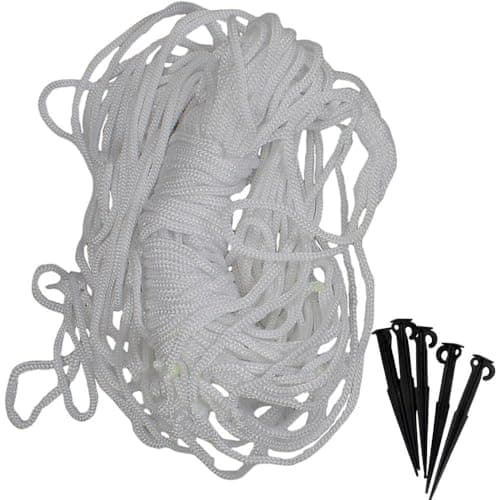
Mega Yard Web, 23 x 18 ft Nylon Web
Various
Roughly 23 by 18 feet of triangular rope web with a gutter bracket at the apex and stakes at the base. Nothing else turns the whole front of a house into one piece for this little effort.
- Size
- About 23.3 x 18.7 ft, triangular
- Material
- Polyester blend rope
- Included
- 1 gutter bracket, 5 ground stakes
- Lighting
- Glows under blacklight (manufacturer stated)
Good
- Scales to the whole facade, which no single prop at this effort level does
- Rope rather than stretch cotton, so it survives rain instead of sagging into string
- The blacklight response gives you a second, completely different look after dark
Less good
- The apex bracket has to go on a gutter, so the top end still means a ladder
- A 23-foot web is a sail — it loads the gutter and the stakes in a real wind
- Stock rotates hard in October; the exact pack is not always on one retailer
- Street presence8.8
- Build quality7.6
- Weather tolerance7.2
- Setup effort6.4
- Storage footprint8.8
#ad How we are funded - price as of November 4, 2026
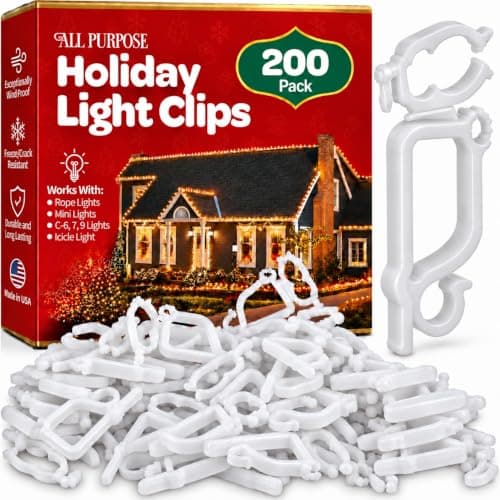
All-Purpose Holiday Light Clips, Set of 200
Various
The clip that ends the argument about how to light a roofline. One shape hooks over a gutter lip or slides under a shingle butt, so a single box covers the whole run of a typical house.
- Type
- Dual-purpose plastic clip, gutter lip or shingle butt
- Count
- Commonly sold in sets of 100, 200 or 400
- Light types
- Mini, C6, C7, C9, rope and icicle (listed)
- Tools
- None — the clip is the fixing
Good
- No nails, screws or staples, so nothing punctures the roof covering
- One clip shape handles both the gutter and the shingle course above it
- Cheap enough to over-buy, and the spares get used again in December
Less good
- Plastic goes brittle in cold; expect to lose some every season
- Shingle mounting means walking or laddering the roof edge, which is the real risk
- Will not grip a gutter guard, a wide fascia or an unusually thick gutter lip
- Damage risk9.6
- Build quality7.0
- Setup effort8.4
- Weather tolerance7.4
- Value9.2
#ad How we are funded - price as of November 4, 2026
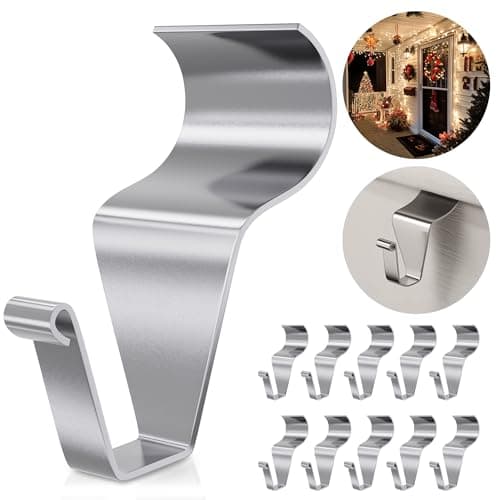
No-Hole Vinyl Siding Hooks, 10 Pcs, Stainless Steel
Amuille
Rolls into the seam between two siding courses and hangs off the lap, so the wall stays unpunctured. If your house is sided, this is the first thing to buy and the cheapest thing on the page.
- Type
- J-shaped hanger that rolls into a siding seam
- Material
- Stainless steel
- Capacity
- 12 lb per hook (manufacturer stated)
- Count
- 20 per pack on this listing
Good
- No hole, so there is nothing for water to get behind later
- Stainless, so it will not rust-streak a light-colored wall
- Reusable season after season — take them out in November and keep the bag
Less good
- Vinyl and some steel lap siding only; useless on stucco, brick or fiber cement
- The stated capacity is per hook in a sound seam, not a license to hang an animatronic
- A hook under tension can bow a soft panel in heat — spread the load over two
- Damage risk9.8
- Build quality8.6
- Setup effort9.4
- Weather tolerance9.0
- Value9.0
#ad How we are funded - price as of November 4, 2026
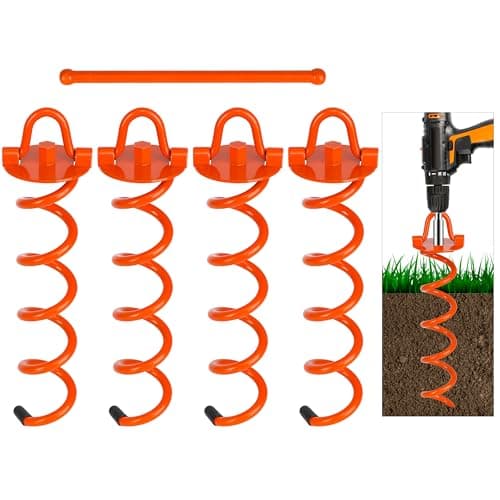
12 in Spiral Ground Anchors, 4 Pack
FEED GARDEN
The single highest-value upgrade in this whole category: the thin U-stakes in the box pull straight out of wet ground, and a corkscrew does not.
- Type
- Spiral or corkscrew ground anchor
- Common length
- 10 to 15 in
- Best ground
- Turf and soil, not gravel or hardstanding
- Installation
- Hand turned, no driving
Good
- Holds in saturated soil where a straight stake lifts
- Screws in by hand, so no mallet and no bent stakes
- Reusable season after season
Less good
- Useless on concrete, pavers or frozen ground, where you need weights instead
- Takes longer to install than driving a U-stake
- Leaves a visible plug hole in a manicured lawn
- Holding power9.2
- Ground versatility6.4
- Durability8.8
- Setup effort8.0
- Value9.0
#ad How we are funded - price as of November 4, 2026
No holes in the house
The rule for every seasonal decoration is that nothing permanent goes into the building envelope. A screw through vinyl siding leaves a hole that will take water behind the cladding for the next twenty years, and a hole in a soffit or a fascia is worse. Every surface has a no-hole fixing that already exists:
| Surface | What to use | Rough capacity |
|---|---|---|
| Gutter lip | Gutter clip or all-purpose light clip | Light loads only, spread them |
| Shingle butt | Shingle-style light clip | Light loads only |
| Vinyl siding | J-shaped siding hook in the seam | About 12 lb per hook as stated |
| Brick | Brick hook clip on the mortar course | Light to moderate |
| Soffit or fascia | Adhesive hook or a fascia bracket | Light loads only |
| Lawn or bed | Corkscrew ground anchor | Far more than a U-stake |
Spread the load wherever you can. Two clips on a gutter at modest tension is a completely different proposition from one clip taking everything, and clips are sold two hundred at a time for a reason. Decorating a house exterior for Halloween covers the rest of the fixings question.
Treat the web as a sail
A web the size of a gable end presents a real surface to the wind, and the load goes to the apex bracket and the ground anchors. The thin U-stakes supplied in the bag are adequate for dry soil and a still evening, and they pull straight out of saturated turf — which is exactly the weather that puts load on them in the first place.
Swap them for corkscrew anchors. They turn in by hand, they hold in wet ground because the soil has to shear rather than slide, and they come back out in November. The same upgrade is the highest-value change you can make to an inflatable — see anchoring Halloween inflatables against wind. On concrete or pavers where nothing can be driven, weighted bags at each base corner are the only honest answer.
Light it from the side
A rope web is thin pale line work. A flood pointed straight at the wall flattens it into nothing, because the light hits the web and the wall equally. Grazing light does the opposite: two spike spots at the base of the facade, aimed up and across the wall, catch every strand and leave the wall behind it darker.
Many rope webs also fluoresce under UV, which is effectively a second decoration for the price of one fixture — the Halloween blacklight setup guide covers doing that without washing out the rest of the yard. For spiders to put on the finished web, the best Halloween spider decorations ranks the formats.
Taking it down without ruining it
Release the base anchors first, then the mid-span clips, then the apex last — the reverse of the order you put it up in. Let the web come down as one piece and fold it rather than stuffing it, because a rope web that goes into the bag as a ball comes out next year as a knot and gets thrown away. Dry it before it is boxed: rope webs are fine wet and mildew in a sealed tote. Storing Halloween decorations covers the rest of the pack-down.
Frequently asked questions
How do you hang a Halloween spider web outside?
Apex first, from a gutter bracket or fascia hook at the highest point. Let the web hang and shake out any twist, then walk the two base corners out and down to ground anchors and tension until the lower edge is straight. Tension is what makes a web read as a web.
How do you attach a spider web to vinyl siding without drilling?
Use J-shaped vinyl siding hooks, which roll into the seam between two siding courses and hang off the lap. They are rated around 12 lb each as stated by the manufacturer, and they leave the wall unpunctured. Never put a screw through siding for a seasonal decoration.
Will a giant spider web damage my gutters?
It can, if the whole load goes through one bracket in a wind. Spread the apex load over two clips or a fascia hook, keep the tension moderate, and take the web down ahead of a storm rather than finding out.
What anchors should you use for the base of a spider web?
Corkscrew ground anchors, not the thin U-stakes in the bag. The supplied stakes pull out of saturated turf, which is the exact condition in which wind is loading them. On concrete or pavers, weighted bags at each corner are the only option.
How do you store a rope spider web?
Dry it first, then fold it as one piece rather than stuffing it in. A rope web packed as a ball comes out next season as a knot. Release it in reverse order — base anchors, mid-span clips, apex last — so it comes down in one piece.
About the author
Mike M.
Mike M. is the hands-on owner behind Iron Mako Media, which publishes Haunt & Hedge. The site covers the gear that builds a yard haunt, for the person who already decorates and adds one bigger piece a year.
Every pick here is chosen from manufacturer specifications, manuals, safety standards and verified buyer data. Read how we choose picks.