Lighting & Projection
How to Use a Black Light for Halloween
UV is not a color you add to a yard. It is a switch that makes some things glow and everything else disappear, and that selectivity is the whole effect.
Disclosure: we earn a commission from qualifying purchases made through links on this page, at no extra cost to you. It does not change what we recommend — here is how we choose.
The short answer
Use a 395 to 400 nm UV flood or spotlight, mounted close to what you want to glow — within about six to ten feet — and remove every other light source from that part of the display. UV works by making white and fluorescent materials emit visible light while everything around them stays dark, so any competing white light destroys the effect instantly.
Blacklight is the cheapest way to make inexpensive props look deliberate, and it is the lighting technique most often installed badly. The usual mistake is treating a UV fixture like a purple floodlight: mount it high, aim it at the whole yard, leave the porch light on, and wonder why nothing glows. UV is short-range and it is exclusive. Get both of those right and a bagged skeleton and a packet of gauze become the best-looking thing on the street.
What actually glows
Fluorescence happens when a material absorbs ultraviolet and re-emits it as visible light. Plenty of ordinary Halloween material does this and plenty does not, and you cannot tell by looking at it in daylight. The reliable glowers:
- White and bone-colored plastic. Most skeletons, skulls and foam props — this is why UV and skeletons go together.
- Rope webs and gauze. Many are stated to fluoresce, which gives you a completely different second look from one purchase.
- White fabric and most whites with optical brighteners. Sheets, cheesecloth, costume shirts.
- Fluorescent and neon paint. The intended use, and the only way to control exactly what glows.
- Teeth, white shoes and highlighter ink. Which is also the reason visitors enjoy standing in it.
What does not glow: black, dark gray, most browns and greens, bare wood, brick, and almost everything in an unlit yard. That is the point. The non-glowing parts go to black, so the glowing parts appear to float with no visible support.
Buy 395 nm, and buy a fixture not a bulb
| Specification | What to look for | Why |
|---|---|---|
| Wavelength | 395 to 400 nm | Strong fluorescence with usable output |
| Rating | IP65 or better | It is living outdoors for a month |
| Housing | Aluminum with a glass lens | Plastic-lens UV units fade fast |
| Beam angle | Narrow to medium, around 60 degrees | UV is short range; concentrate it |
| Form | Flood or spot with an adjustable head | You will re-aim it several times |
| Count | More small units beat one big one | Coverage is about proximity, not power |
Wavelength is the spec that matters. Shorter-wavelength units make things glow more intensely but put out less visible light to aim by; longer ones look more purple and fluoresce less. The 395 to 400 nm band is the practical compromise, and it is what most outdoor UV floods are built around.
Fixtures for this job
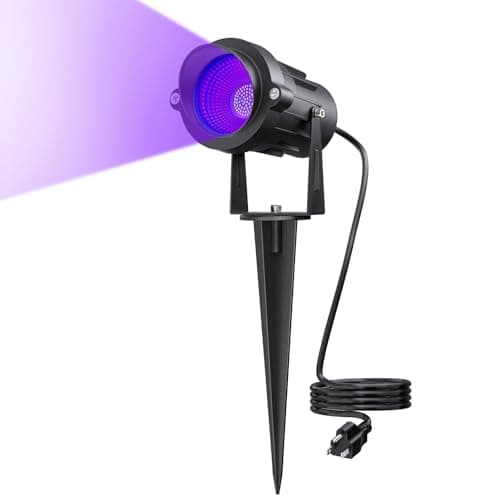
18W UV Blacklight Spotlight, IP65
Onforu
Not a color, an effect. UV makes white bone, gauze and paint fluoresce, which is the one lighting trick that makes a cheap skeleton look expensive.
- Power
- 12W
- Wavelength
- About 395 to 400 nm
- Rating
- IP65, aluminum housing with glass lens
- Beam
- Around 60 degrees with an adjustable head
Good
- Transforms white plastic skeletons and gauze for very little money
- Metal housing and glass lens, not the usual plastic shell
- Adjustable head lets you place the unit for concealment, not aim
Less good
- Does nothing at all to props that are not white or fluorescent
- Needs proper darkness — porch light ruins it
- Narrow useful range, so it must be close to what it lights
- Effect strength8.4
- Build quality8.4
- Weather tolerance8.4
- Ease of setup8.6
- Control6.0
#ad How we are funded - price as of November 4, 2026
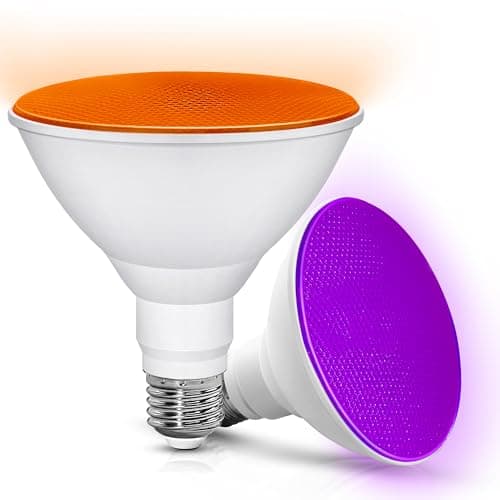
PAR38 Orange and Purple LED Flood Bulbs, 15W
Various
If the house already has outdoor floodlight fixtures, colored PAR38 bulbs are the cheapest color change on this site. No app, no controller, no cord run.
- Fitting
- Standard E26 PAR38
- Use
- Existing outdoor flood fixtures
- Rating
- Buy wet or damp rated to match the fixture
- Control
- The switch that is already there
Good
- No new wiring, no new controller, no new cord
- Cheapest color-change option available
- Nothing extra to store, because they stay in the fixture or in a small box
Less good
- Fixed colors, so no scenes and no fading
- Only works if the fixtures point somewhere useful
- Cheap colored LEDs vary a lot in actual output
- Brightness7.4
- Color quality6.8
- Weather rating8.0
- Control4.5
- Value9.6
#ad How we are funded - price as of November 4, 2026
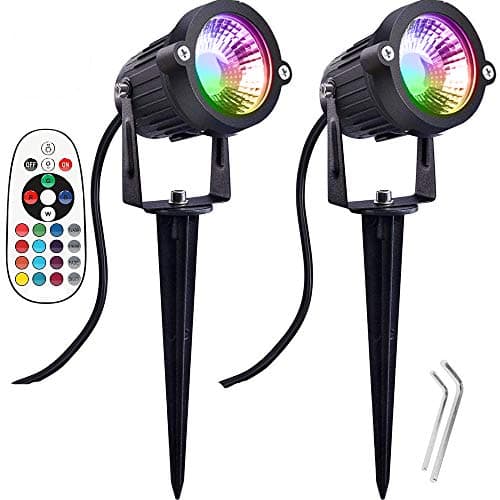
Low-Voltage RGB Landscape Spotlights with Spike Stands, 2 Pack
WeFoonLo
Six metal-bodied spots on spikes, color-set from a phone or remote. Buying spots in a pack is the right move because one prop lit well looks worse than four lit consistently.
- Contents
- Commonly packs of four or six
- Rating
- IP65
- Control
- App and remote, per-light color on better sets
- Mounting
- Ground spike, adjustable head
Good
- Consistent color across the whole yard from one controller
- Metal bodies survive being kicked and stood on
- Adjustable heads mean the aim is fixable without moving the spike
Less good
- Daisy-chained low-voltage cable needs planning before you stake anything
- App-controlled sets depend on a phone and a working network
- Spikes do not hold in hard or sandy ground
- Effect strength8.6
- Build quality8.0
- Weather tolerance8.4
- Ease of setup7.2
- Control8.8
#ad How we are funded - price as of November 4, 2026
Kill the competing light
This is the step that decides whether the effect works, and it costs nothing. UV fluorescence is dim in absolute terms. Any ordinary white light falling on the same props swamps it, and the glow vanishes — not dims, vanishes. On most houses the culprits are predictable:
- The porch light. Switch it off, or put a colored bulb in it and accept it is now part of the design.
- Interior light through a front window. Close the blinds on any window facing the UV zone.
- Your own other fixtures. Do not run a white flood and a UV flood on the same props; pick one per zone.
- The street light. The one you cannot switch off. Put the UV zone on the shadowed side of the house, away from it.
- Motion-sensor security lights. They will fire at every visitor and erase the effect at exactly the wrong moment. Disable them for the month.
The street-light constraint is why UV almost always works better on a porch, in a garage, under a carport, or in a side yard than it does on an open front lawn. Pick the darkest area you have and build the UV scene there rather than fighting ambient light across the whole display.
Get the fixture close
UV output falls off quickly with distance, so a fixture mounted on the eaves aimed at the lawn does very little. Six to ten feet from the props is the useful range for a typical outdoor UV flood. In practice that means ground-level spike fixtures tucked behind a tombstone or a shrub, aimed up and across at close range — not a single unit trying to cover everything.
Two or three small units placed close beats one powerful unit placed far, for the same reason that four props lit consistently beat one prop lit well. Halloween spotlights and outdoor Halloween lights cover the fixture types, and the Halloween lighting color guide covers how to use UV alongside colored light without the two cancelling out.
Where UV is the right answer
UV earns its place in three specific scenes. A bone yard, because every white skeleton in it lights up and the ground goes black. A web-covered facade, because rope web is thin pale line work that UV picks out strand by strand — see how to hang a Halloween spider web outside. And an entry or a tunnel, where visitors walk through it and discover their own clothing is glowing, which is the one lighting effect that involves the audience.
Where it is the wrong answer: as general yard lighting, as the only light on a path people walk down, or anywhere you need visitors to see a step. UV reveals selected objects and hides the ground, which makes it a genuine trip hazard if it is doing the job of a path light. Keep a warm low-level light on any walking surface — yard haunt electrical safety covers that, and how to decorate a house exterior covers layering the zones.
Two things that make it look intentional
First, add fluorescent paint rather than relying on what happens to glow. A few dollars of neon paint on foam tombstones, on the inside of a cauldron, or in splatter on a white sheet gives you control over exactly which parts light up — which is the difference between a UV effect and a UV accident. The black lights roundup covers the fixtures and the paint together.
Second, put the UV zone on a timer with everything else. A UV flood left on all night is both a waste and the thing that makes a display look unattended. Timers and smart plugs covers switching the whole display at dusk, and when to put up Halloween decorations covers how long all of it should be running.
Frequently asked questions
How do you use a black light for Halloween?
Mount a 395 to 400 nm UV flood within six to ten feet of the props you want to glow, aimed up and across them, and switch off every other light in that part of the display. UV fluorescence is dim in absolute terms, so competing white light erases it completely.
What wavelength black light is best for Halloween?
395 to 400 nm. Shorter wavelengths fluoresce more strongly but give you almost no visible light to aim by; longer ones look more purple and glow less. The 395 nm band is the practical compromise and is what most outdoor UV floods use.
What glows under a black light?
White and bone-colored plastic, which covers most skeletons and foam props; rope webs and gauze, many of which are stated to fluoresce; white fabric with optical brighteners; and fluorescent paint. Dark colors, brick and bare wood do not, which is what makes the effect selective.
Why is my black light not making anything glow?
Almost always competing light — a porch light, a window with the blinds open, a motion-sensor security light, or a street light. The other common cause is distance: UV falls off fast, so a fixture on the eaves aimed at the lawn is too far away to do anything.
Can you leave a UV blacklight outside all month?
Yes, if it is rated for it. Look for IP65 or better with an aluminum body and a glass lens — plastic-lens UV units degrade quickly in sunlight. Put it on the same timer as the rest of the display rather than leaving it running overnight.
About the author
Mike M.
Mike M. is the hands-on owner behind Iron Mako Media, which publishes Haunt & Hedge. The site covers the gear that builds a yard haunt, for the person who already decorates and adds one bigger piece a year.
Every pick here is chosen from manufacturer specifications, manuals, safety standards and verified buyer data. Read how we choose picks.