Fog & Atmosphere
How Long Does a Fog Machine Take to Warm Up?
Three to ten minutes, depending on the machine — and the reheat between bursts is the number that actually ruins parties.
Disclosure: we earn a commission from qualifying purchases made through links on this page, at no extra cost to you. It does not change what we recommend — here is how we choose.
The short answer
Most Halloween fog machines take three to ten minutes to reach operating temperature from cold: roughly three to five minutes for a 400W to 700W unit, five to eight for a 1000W, and up to ten for a 1500W or a machine with a large heat exchanger. Switch it on fifteen minutes before you want fog, and plan for a reheat pause of thirty seconds to two minutes between bursts.
A fog machine is a pump, a tank and a block of aluminum with a heating element in it. Fluid is pushed through the hot block, flashes to vapour and condenses into fog as it hits room air. Nothing happens until that block is up to temperature, which is why a machine switched on as the first guests arrive produces a spit of liquid and a thermostat light for the next five minutes.
Warm-up by machine size
| Machine | Cold start | Reheat between bursts | Suits |
|---|---|---|---|
| 400W compact | About 3 to 5 minutes | 30 to 60 seconds | A room, a porch, a single prop |
| 700W to 1000W | About 5 to 8 minutes | 45 to 90 seconds | A front yard or a large room |
| 1200W to 1500W | Up to 10 minutes | Often continuous output | A full yard haunt or a hall |
| Low-lying or ice-cooled | Machine time plus ice loading | As the machine, plus ice life | Ground fog around props |
| Dry ice unit | Water heating time, typically 10 to 20 minutes | Continuous while ice lasts | The thickest ground fog |
These are the figures to plan around rather than specifications to hold a manufacturer to — ambient temperature changes them. A machine sitting in a 40 degree yard in late October takes noticeably longer to come up than the same machine indoors, and it drops below temperature faster between bursts.
The reheat cycle is the number that matters
Cold start is a one-time cost you can schedule around. The reheat is what you live with all evening. Pushing fluid through the heat block pulls heat out of it, so after a burst the machine has to recover before it can produce full-density fog again. On a smaller machine that is thirty to sixty seconds of nothing; on an undersized machine trying to fill a big space it can be two minutes, which feels like forever when there are people standing in the yard.
This is the single best argument for buying a machine a size up from what you think you need, and the reason a timer-equipped machine is worth having. What size fog machine do I need works through the sizing, and the best Halloween fog machine with a timer covers the units that manage their own burst cycle.
Machines that handle the cycle well
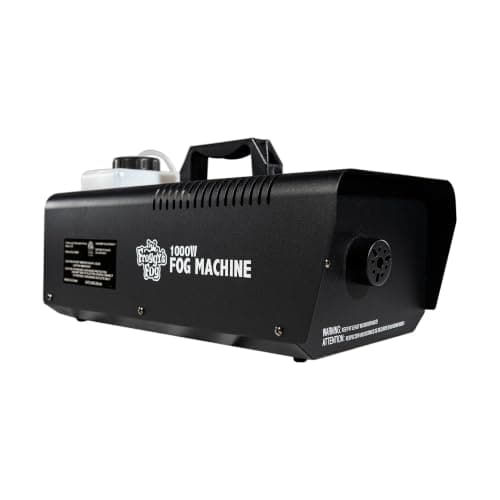
1000 Watt Halloween Fog Machine with Wired Remote
Froggys Fog
All-metal housing with timer and remote options, from a maker that also sells the fluid. Costs more than the generic 1000W units and is the one most likely to still work in five years.
- Output
- 1000W
- Housing
- All metal
- Control
- Wired remote, with timer and wireless options
- Placement
- Sheltered position, vented and off wet ground
Good
- Metal body survives being knocked about season after season
- Timer and wireless control are available rather than fixed
- Fluid from the same maker, so no guesswork on compatibility
Less good
- Costs noticeably more than the generic timer machines
- The wired remote means a second cable to route and hide
- Still not weather rated — shelter is mandatory
- Output8.4
- Timer control8.0
- Build quality8.8
- Setup effort7.6
- Value7.6
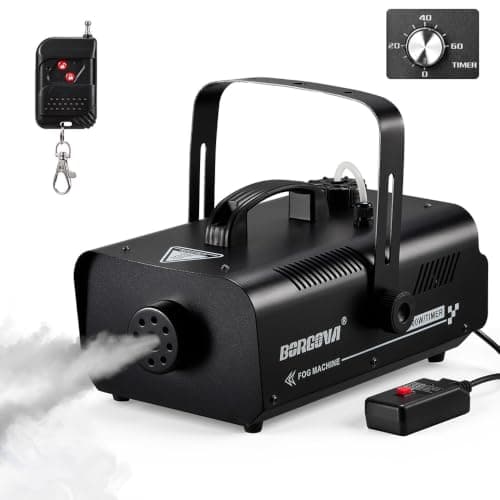
1000W Fog Machine with Timer and Wireless Remote
BORGOVA
An on-board timer with an interval and duration you set once, plus a long-range wireless remote for manual bursts. The timer being internal is the whole point — nothing to leave in the rain.
- Output
- 1000W
- Timer
- Built in, commonly a 0 to 30 minute interval range
- Remote
- Wireless, useful range around 150 ft
- Warm-up
- Roughly 3 to 4 minutes from cold
Good
- The interval is set on the machine, so there is no separate box to weatherproof
- Wireless remote overrides the timer for a manual burst when someone arrives
- 1000W is the sweet spot for a front yard — enough output without emptying the tank
Less good
- Timer granularity is coarse on cheap units, so fine control is limited
- Reheat cycles mean it will not fire on demand every time
- The machine itself still needs a sheltered position
- Output8.2
- Timer control8.8
- Build quality7.0
- Setup effort8.6
- Value8.6
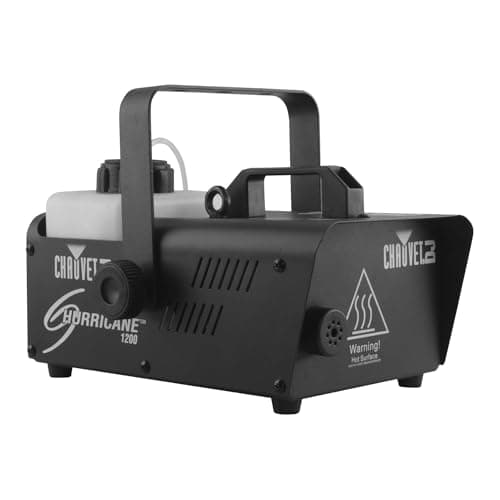
Hurricane 1200 Fog Machine
Chauvet DJ
A mainstream heated fogger from a brand with actual parts support, which makes it the sensible base machine to pair with a chiller rather than a disposable seasonal unit.
- Type
- Heated fog machine
- Fluid
- Water-based fog fluid
- Output
- 18,000 CFM
- Control
- Timer remote, with a manual fog button
Good
- Parts and fluid support from an established brand
- Good base unit for a DIY or bought chiller setup
- Two-minute heat-up, which is fast for a heated machine
Less good
- Produces rising fog unless it is chilled
- Duty cycle means it pauses to reheat
- More machine than a small porch display needs
- Fog density8.4
- Stays low4.0
- Run time7.4
- Setup effort8.6
- Consumable cost7.4
#ad How we are funded - price as of November 4, 2026
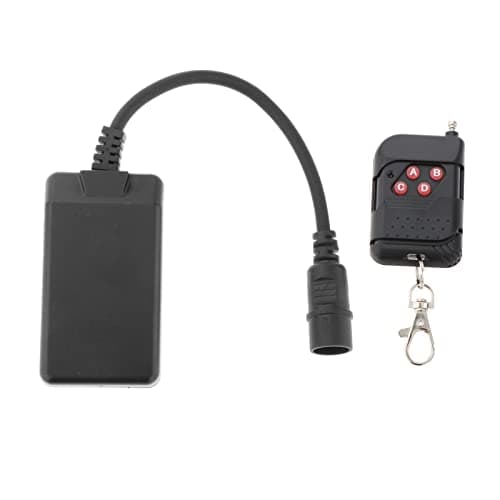
Wireless Fog Machine Remote and RC Receiver
Various
Released bursts beat a machine running flat out. Fog you let out in waves reads as atmosphere; fog you let out constantly reads as a house fire — and this is the remote-and-receiver pair that lets you do it from the porch.
- Type
- Wireless remote plus RC receiver, sold as a replacement part
- Fits
- 400W to 1500W stage and smoke machines
- Fit check
- Connector is machine-specific, so verify before buying
- Range
- Varies, so check against your yard depth
Good
- Manual bursts make a modest machine look like a bigger one
- Saves fluid by not running continuously
- Lets you trigger from the porch instead of crouching in a flower bed
Less good
- Connectors are not universal, so fitment matters
- Cheap remotes lose pairing in cold weather
- Another battery to check on the night
- Control quality8.2
- Fluid savings8.6
- Range7.0
- Setup effort8.4
- Value8.8
When to switch it on before a party
- Thirty minutes before, set the machine up, fill the tank and check the fluid level. Running a machine dry is how pumps die.
- Fifteen minutes before, switch it on and leave it. This is the only part people skip.
- Ten minutes before, fire one test burst. You want to find a blocked nozzle now, not when the first guests are at the gate.
- Five minutes before, lay the base layer — one longer burst so the space already has atmosphere when people walk in.
- Through the evening, short bursts on a cycle rather than long ones on demand.
If the machine is outdoors and the evening is cold, add five minutes to everything. If it is going to run unattended, a remote or a timer is what turns this from a job into a setting.
Leaving it on standby, and whether that is a good idea
A fog machine left switched on holds temperature and is ready instantly, which is exactly what you want across a four-hour evening. The cost is that the element cycles the whole time and the fluid in the block is being held hot, which over many hours is harder on the machine than it needs to be.
The sensible middle is to leave it on for the hours people are actually around — say six until ten — and switch it off at the wall afterwards rather than leaving it hot overnight. If the machine is on an outdoor timer, give it a few minutes of lead time before the rest of the display comes on so it is ready when the lights are. The best timers and smart plugs for Halloween covers the outdoor-rated options.
When a long warm-up means something is wrong
- It never reaches temperature. Usually a failing heating element or a thermostat stuck open; the ready light keeps cycling and the output stays thin.
- It heats but spits liquid. Fluid is getting through without flashing — often a partly blocked nozzle, or fluid that is too thick for the machine.
- It is slower than it used to be. Scale and residue in the heat exchanger. Running a cleaning solution through it at the end of the season is what prevents this.
- It cuts out mid-burst. Thermal cut-out doing its job, usually because the burst was too long for the machine or the inlet is blocked.
Fog machine troubleshooting goes through the faults in order, and how to protect a fog machine from rain covers the enclosure, which is what stops most outdoor failures before they start.
Frequently asked questions
How long does a fog machine take to warm up?
Three to ten minutes from cold, depending on size: roughly three to five minutes for a 400W to 700W machine, five to eight for a 1000W, and up to ten for a 1500W. Cold ambient temperature adds to all of these.
How long between fog machine bursts?
Thirty seconds to two minutes, depending on the machine and the burst length. Pushing fluid through the heat block cools it, so the machine has to recover before it can make full-density fog again. Undersized machines have the longest recovery.
When should you turn a fog machine on before a party?
About fifteen minutes before you want fog. Set it up and fill it half an hour ahead, switch it on at fifteen minutes, test-fire at ten, and lay a base layer at five so the room already has atmosphere when guests arrive.
Can you leave a fog machine on all evening?
Yes, and for a four-hour party it is the practical choice because the machine stays at temperature and is ready instantly. Switch it off at the wall afterwards rather than leaving it hot overnight.
Why is my fog machine taking longer to heat up than it used to?
Usually scale and fluid residue building up in the heat exchanger, which insulates the block. Running a cleaning solution through at the end of each season prevents it. A ready light that cycles without the machine ever producing good fog points at the element or thermostat instead.
About the author
Mike M.
Mike M. is the hands-on owner behind Iron Mako Media, which publishes Haunt & Hedge. The site covers the gear that builds a yard haunt, for the person who already decorates and adds one bigger piece a year.
Every pick here is chosen from manufacturer specifications, manuals, safety standards and verified buyer data. Read how we choose picks.