Storage & Off-Season
When Should You Put Up Halloween Decorations?
Most people pick a date. The better approach is to stage it: the things that take weather go up last, and the things that take time go up first.
Disclosure: we earn a commission from qualifying purchases made through links on this page, at no extra cost to you. It does not change what we recommend — here is how we choose.
The short answer
The first weekend of October is the practical answer for most displays, which gives you about four weeks up. Stage it rather than doing it in one day: non-powered and weather-tolerant items — tombstones, fencing, webs, lighting — go up first, and anything fabric, motorised or inflatable goes up in the last week or two, because every extra day outdoors is a day of wear it did not need.
There is no etiquette rule here worth worrying about. What there is instead is a genuine trade-off: display time against prop lifespan, lawn health and the odds of a storm. A yard that goes up on the 20th of September has forty days of weather exposure on every piece in it, and the pieces that cost the most are the ones that tolerate it worst.
The staged schedule
| When | What goes up | Why then |
|---|---|---|
| Late September | Nothing outdoors; test everything indoors | Find the dead blower before you need it |
| First weekend of October | Tombstones, fencing, webs, staked props | Weather-tolerant and time-consuming |
| First weekend of October | Lighting, cord runs, timers | The longest job, and best done in daylight |
| Mid-October | Giant skeletons and standing props | Visible payoff, two weeks of exposure |
| Last week | Inflatables, animatronics, fabric figures | The pieces that wear fastest outdoors |
| On the night | Fog machine, strobes, triggered props | Consumables and electronics that should not sit out |
The late-September row is the one that saves the most grief. Plug in every animatronic, inflate every inflatable on the garage floor, and run every fog machine for thirty seconds before any of it is in the yard. A blower that died in storage, a cracked fluid line or a dead power adapter is a cheap problem in September and an unfixable one on the 30th of October. Halloween inflatable troubleshooting and fixing Halloween animatronics cover what to do when the test fails.
Lighting first, props later
If you only take one piece of sequencing advice: do the lighting and the cord runs on the first weekend, in daylight, with nothing else in the way. It is the longest and least enjoyable part of the job, it is much harder to retrofit around finished scenes, and it is the part that decides whether anything you bought is visible after seven o'clock.
That means planning the circuit before the props arrive in the yard: where the outlets are, where the cords run, where the joints sit, and what switches it all on. Hiding extension cords in a yard, Halloween decoration power draw and timers and smart plugs cover the three halves of that, and doing it first means every prop added later simply plugs into something that already works.
What makes an early setup survivable
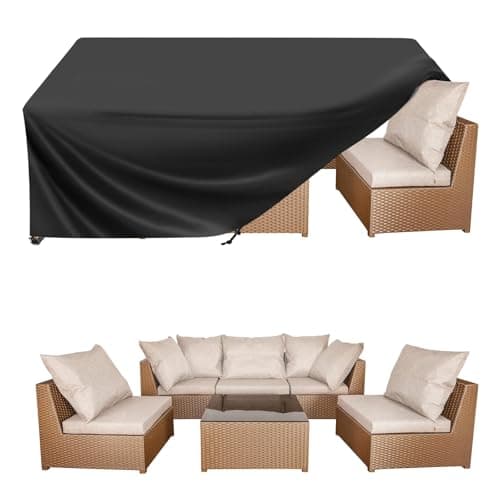
Heavy-Duty Waterproof Outdoor Cover
BALEINE
The pragmatic answer to a prop that is rated for light moisture and a forecast that is not: cover it overnight, uncover it at dusk.
- Material
- Coated polyester or vinyl
- Fit
- Size to the prop's standing footprint
- Securing
- Drawcord or strap
- Breathability
- Vented covers dry faster
Good
- Extends the life of a light-moisture-rated prop by whole seasons
- Cheaper than replacing one animatronic
- Doubles as the off-season dust cover in the garage
Less good
- Only works if somebody actually puts it on before the rain
- A non-vented cover traps condensation, which is its own problem
- Covers blow away, so they need tying down too
- Protection8.6
- Fit versatility7.4
- Durability8.0
- Ease of use7.6
- Value8.8
#ad How we are funded - price as of November 4, 2026
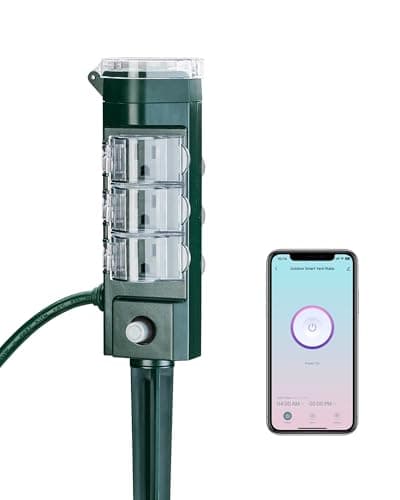
Outdoor Smart Wi-Fi Plug Timer, 6-Outlet Power Stake
HBN
Six weatherproof outlets on a stake, with scheduling. This is the part that turns a pile of extension cords into a display that switches itself on at dusk.
- Outlets
- 6, weatherproof
- Form
- Ground stake with a short lead
- Control
- Wi-Fi app scheduling
- Placement
- Central to the display, off the ground
Good
- One cord from the house instead of six
- Scheduling means the display runs whether or not you are home
- Weatherproof outlet covers rather than open sockets
Less good
- Wi-Fi at the far end of a yard is often the real limitation
- Total load across six outlets still has to stay inside the circuit
- App account required, which some people will not want
- Weather rating8.6
- Outlet count9.4
- Scheduling9.2
- Setup effort8.4
- Value8.6
#ad How we are funded - price as of November 4, 2026
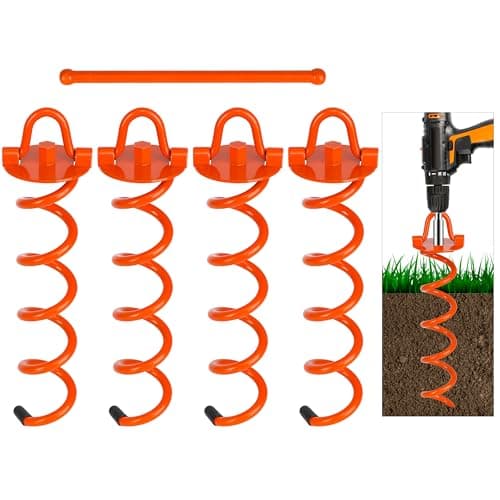
12 in Spiral Ground Anchors, 4 Pack
FEED GARDEN
The single highest-value upgrade in this whole category: the thin U-stakes in the box pull straight out of wet ground, and a corkscrew does not.
- Type
- Spiral or corkscrew ground anchor
- Common length
- 10 to 15 in
- Best ground
- Turf and soil, not gravel or hardstanding
- Installation
- Hand turned, no driving
Good
- Holds in saturated soil where a straight stake lifts
- Screws in by hand, so no mallet and no bent stakes
- Reusable season after season
Less good
- Useless on concrete, pavers or frozen ground, where you need weights instead
- Takes longer to install than driving a U-stake
- Leaves a visible plug hole in a manicured lawn
- Holding power9.2
- Ground versatility6.4
- Durability8.8
- Setup effort8.0
- Value9.0
#ad How we are funded - price as of November 4, 2026
How long each class of prop can stay out
- Foam tombstones, fencing, rope web, staked props. The full month, as long as they are anchored properly. These are what an early setup should consist of.
- Outdoor-rated lighting. The full month. Put it on a timer so it is not running at 3am.
- Giant skeletons and rigid plastic props. Two to three weeks comfortably. Longer is fine; expect some UV fading on colored parts.
- Inflatables. One to two weeks of actual run time. Fabric abrades every hour the blower runs, and seams are the failure point — see how long Halloween inflatables last.
- Animatronics and fabric figures. One to two weeks, under cover. Most are rated for light moisture only.
- Fog machines, strobes, projectors. Out on the night, or in a vented enclosure. Not left on a lawn for a month.
Watch the forecast, not the calendar
The most useful habit in October is checking the week ahead before putting anything expensive out. One windy night will do more damage than three weeks of ordinary weather, and the props at risk are predictable: anything tall, anything inflatable, anything with a flat face. If a genuine storm is coming, deflate the inflatables and lay the tall props down. It takes twenty minutes and it is the difference between a display and a repair.
For the days when it is only rain, a cover over the fabric props overnight and off again at dusk is the whole fix. Weatherproofing Halloween decorations covers the rest, and anchoring against wind covers the part you should do once rather than every week.
What the lawn can take
Grass is the part of the display nobody plans for. Anything that covers the ground completely — a deflated inflatable, a tarp, a flat prop lying on turf — starts yellowing the grass underneath in about four days and kills it in a week or two. Staked props are fine; ground cover is not.
The practical rules are simple: do not leave an inflatable deflated on the lawn during the day, move anything flat every few days, and pull the anchors the same week the display comes down. Keeping Halloween decorations from killing your grass has the full version.
And when to take it down
The first dry weekend in November, and the emphasis is on dry. Nothing should be boxed damp — a fabric prop or a rope web packed wet becomes a mildewed prop in a sealed tote by February, and that is the single most common way decorations are lost between seasons. If the weather does not cooperate, bring things into a garage to dry before they go anywhere near a box.
Pack-down is also when next October gets decided, which is why it is worth doing properly rather than fast. Storing Halloween decorations, storing inflatables and animatronics and storing a 12 ft skeleton cover the three jobs, and Halloween storage bins covers what to put it all in.
Frequently asked questions
When should you put up Halloween decorations?
The first weekend of October suits most displays, giving about four weeks up. Stage it rather than doing it all at once: weather-tolerant items like tombstones, fencing, webs and lighting go up first, and fabric, motorised and inflatable props go up in the last week or two.
Is it too early to decorate for Halloween in September?
Not socially, but it costs you. Going up in late September means forty days of weather on every piece, and the expensive pieces tolerate it worst. If you want an early start, put up the foam, fencing, webs and lighting in September and hold the inflatables and animatronics back.
How long can you leave Halloween inflatables up?
One to two weeks of actual run time is the sensible limit. Fabric abrades every hour the blower runs and seams are the failure point. Run them from a timer so they are up in the evening and down overnight, which roughly triples the life of the piece.
When should you take Halloween decorations down?
The first dry weekend in November. The dry part matters more than the date — anything boxed damp will come out of storage mildewed. If the weather is wet, bring things into a garage to dry before they go near a tote.
Will Halloween decorations kill my grass?
Only the ones that cover the ground completely. A deflated inflatable or a flat prop lying on turf starts yellowing the grass in about four days. Staked props are fine. Do not leave inflatables deflated on the lawn during the day, and pull the anchors the week the display comes down.
About the author
Mike M.
Mike M. is the hands-on owner behind Iron Mako Media, which publishes Haunt & Hedge. The site covers the gear that builds a yard haunt, for the person who already decorates and adds one bigger piece a year.
Every pick here is chosen from manufacturer specifications, manuals, safety standards and verified buyer data. Read how we choose picks.