Lighting & Projection
How to Light Up a 12 ft Skeleton
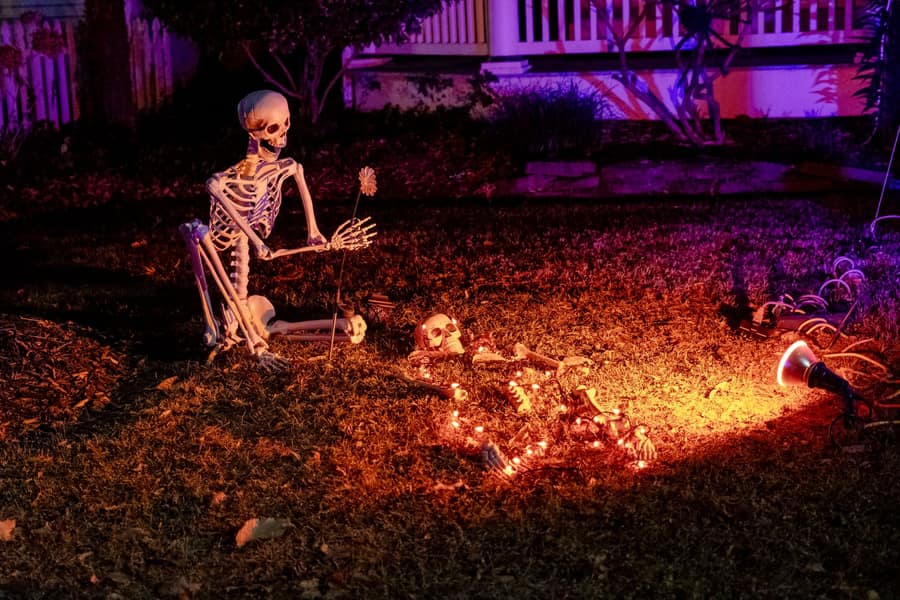
A twelve-foot skeleton is the most expensive thing in most yards and the most likely to be invisible by eight in the evening.
Disclosure: we earn a commission from qualifying purchases made through links on this page, at no extra cost to you. It does not change what we recommend — here is how we choose.
The short answer
Light a 12 ft skeleton with two narrow spotlights at the base, one on each side, angled up along the body and tilted slightly outward so the beams cross above the hips. That gives you shape, shadow and a lit face without the flat wall of light a single flood produces. Keep the beams narrow, keep them off the house behind, and use one color rather than two.
Giant skeletons are bone-colored, which is to say a pale neutral that looks superb against a daytime sky and disappears against a dark one. The prop is also mostly air: a skeleton is a thin outline with gaps, so it catches very little stray light from a streetlamp. Unless you light it deliberately, the most expensive thing in your yard stops existing at dusk, which is exactly when the people you bought it for walk past.
Two spots, not one flood
The instinct is to buy the brightest flood available and point it at the prop. That produces a lit skeleton with no shape — front lighting kills shadow, and shadow is the only thing that makes a three-dimensional prop read as three-dimensional. It also throws a large bright rectangle onto the front of your house, which is the single most common look-at-my-floodlight mistake in yard decorating.
Two narrow spots at ground level, one either side of the feet, is the arrangement that works. Aim each one up the body rather than at it, angled slightly outward so the beams cross somewhere around the hips and the skull is lit from both sides. The ribs and pelvis throw shadows across the prop, the silhouette reads against the sky, and the face is visible — and the face is the whole point of a skeleton.
| Placement | Effect | Watch for |
|---|---|---|
| Two narrow spots at the feet, angled up | Shape, shadow, lit face | Keep spill off the house behind |
| Single flood from the front | Flat, washed out | Avoid; this is the common mistake |
| One spot from behind | Silhouette only, no detail | Dramatic, but the face disappears |
| Spot from one side only | Strong shadow, half the prop dark | Works if the dark side faces away from the street |
| Ultraviolet at the base | Glow on any white or pale surface | Weak at distance; pair with a normal spot |
Narrow beams, and why wide ones lose
A twelve-foot prop is tall and thin. A wide flood spreads its light across an area many times the size of the target, which means most of the output lands on the lawn, the hedge and the siding rather than on the skeleton. A narrow spot concentrates the same output onto the prop, so a modest fixture aimed well beats a powerful one aimed loosely.
If the only fixtures you have are floods, you can get most of the way there by moving them much closer to the base of the prop and tilting them steeply upward. The closer the fixture, the less of its spread is wasted. The best Halloween spotlights covers the narrow-beam fixtures, and outdoor Halloween lights covers the wider category.
Fixtures that do this job
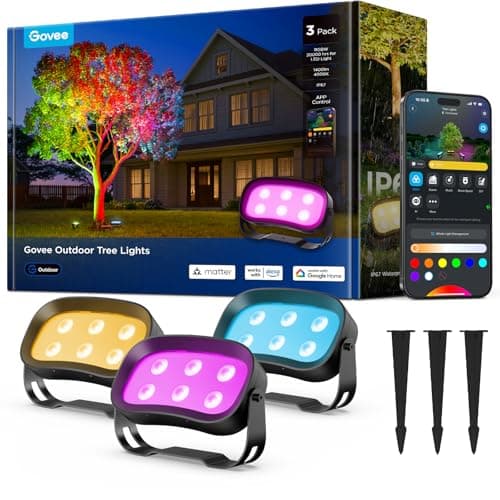
Outdoor Tree Lights, 3 Pack, RGBWIC Landscape Lighting
Govee
Spots do the job floods cannot: put light on the animatronic and leave the rest of the yard dark, which is what makes a display read as staged instead of lit.
- Contents
- 3 landscape uplights per set
- Beam
- Narrow uplight, aimable head
- Color
- RGBWIC, addressable color plus white
- Control
- App
Good
- Narrow beam means contrast, and contrast is what makes props read at night
- Three in a set, which is the minimum to stage a scene rather than spotlight one thing
- Same app ecosystem as the floods, so scenes stay in sync
Less good
- Needs aiming, and aiming needs doing again after the first mow
- Low stake height means splashback in heavy rain
- A spot pointed at a neighbor's window is a conversation you do not want
- Brightness8.0
- Color quality9.0
- Weather rating8.2
- Control9.0
- Value8.2
#ad How we are funded - price as of November 4, 2026
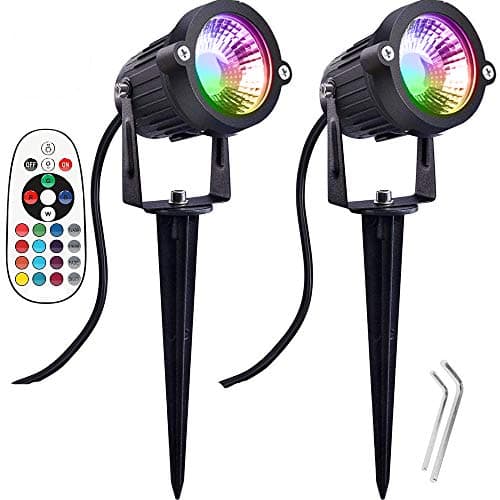
Low-Voltage RGB Landscape Spotlights with Spike Stands, 2 Pack
WeFoonLo
Six metal-bodied spots on spikes, color-set from a phone or remote. Buying spots in a pack is the right move because one prop lit well looks worse than four lit consistently.
- Contents
- Commonly packs of four or six
- Rating
- IP65
- Control
- App and remote, per-light color on better sets
- Mounting
- Ground spike, adjustable head
Good
- Consistent color across the whole yard from one controller
- Metal bodies survive being kicked and stood on
- Adjustable heads mean the aim is fixable without moving the spike
Less good
- Daisy-chained low-voltage cable needs planning before you stake anything
- App-controlled sets depend on a phone and a working network
- Spikes do not hold in hard or sandy ground
- Effect strength8.6
- Build quality8.0
- Weather tolerance8.4
- Ease of setup7.2
- Control8.8
#ad How we are funded - price as of November 4, 2026
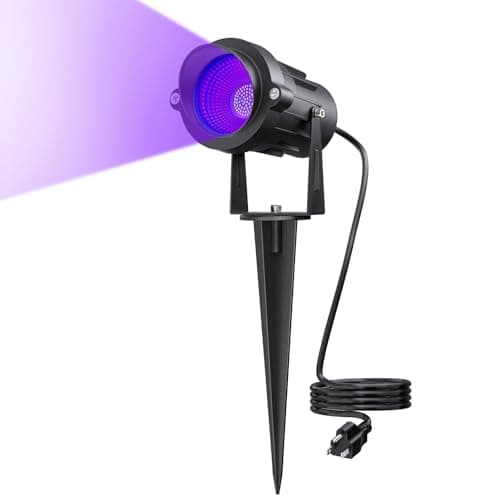
18W UV Blacklight Spotlight, IP65
Onforu
Not a color, an effect. UV makes white bone, gauze and paint fluoresce, which is the one lighting trick that makes a cheap skeleton look expensive.
- Power
- 12W
- Wavelength
- About 395 to 400 nm
- Rating
- IP65, aluminum housing with glass lens
- Beam
- Around 60 degrees with an adjustable head
Good
- Transforms white plastic skeletons and gauze for very little money
- Metal housing and glass lens, not the usual plastic shell
- Adjustable head lets you place the unit for concealment, not aim
Less good
- Does nothing at all to props that are not white or fluorescent
- Needs proper darkness — porch light ruins it
- Narrow useful range, so it must be close to what it lights
- Effect strength8.4
- Build quality8.4
- Weather tolerance8.4
- Ease of setup8.6
- Control6.0
#ad How we are funded - price as of November 4, 2026
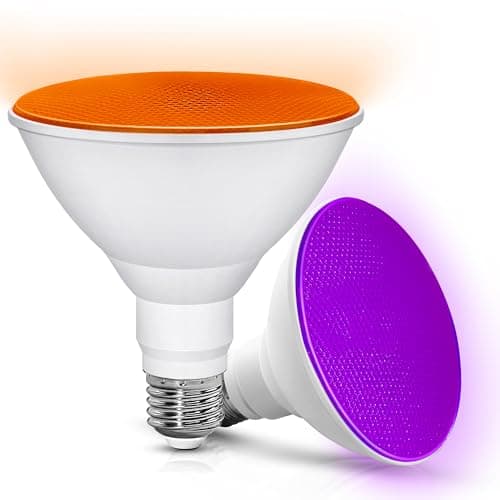
PAR38 Orange and Purple LED Flood Bulbs, 15W
Various
If the house already has outdoor floodlight fixtures, colored PAR38 bulbs are the cheapest color change on this site. No app, no controller, no cord run.
- Fitting
- Standard E26 PAR38
- Use
- Existing outdoor flood fixtures
- Rating
- Buy wet or damp rated to match the fixture
- Control
- The switch that is already there
Good
- No new wiring, no new controller, no new cord
- Cheapest color-change option available
- Nothing extra to store, because they stay in the fixture or in a small box
Less good
- Fixed colors, so no scenes and no fading
- Only works if the fixtures point somewhere useful
- Cheap colored LEDs vary a lot in actual output
- Brightness7.4
- Color quality6.8
- Weather rating8.0
- Control4.5
- Value9.6
#ad How we are funded - price as of November 4, 2026
Color: pick one and commit
Bone takes color extremely well, which is a trap — because every color works, people use three. Two colors from opposite sides make a skeleton look like a stage set. One color, with the second fixture matching, keeps the prop coherent and lets the rest of the yard provide the contrast.
- Cold white or pale blue — the most convincing bone. Reads as moonlight and keeps the prop looking like a skeleton rather than a prop.
- Deep orange or amber — warm, classic, friendlier. Good on a street with small children.
- Green — strong and theatrical; correct for a witch-themed yard, overpowering on its own.
- Red — use sparingly and from low down. Red from above reads as a traffic light; red from the ground reads as fire.
- Ultraviolet — makes white and pale surfaces glow. Beautiful close up, weak beyond fifteen feet, so pair it with a normal spot.
The Halloween lighting color guide covers the pairings across a whole yard, and the Halloween blacklight setup guide covers ultraviolet properly if that is the direction you want.
Cables, stakes and the wind
Two fixtures at the base of a giant means two cables at the base of a giant, in the one spot where people will be standing to take photographs. Route them away along the edge of a bed rather than across the lawn, stake them down, and keep every joint out of standing water. Spike-mounted fixtures work loose over six weeks — push them back in when you check the prop.
One more thing that is easy to miss: a fixture at the base of a twelve-foot prop is inside the area that prop will land in if it goes over. How to keep a 12-foot skeleton from falling over covers the anchoring, and how to hide extension cords in a yard covers the routing. Yard haunt electrical safety covers the outlet end.
Fog is the cheapest upgrade to a lit giant
Once the skeleton is lit, a thin layer of low fog around the base does two things at once: it hides the stakes, the fixtures and the cables, and it gives the light beams something to show up in. A lit giant rising out of ground fog is a different photograph from a lit giant standing on a lawn, and it costs a short burst from a small machine.
The best low-lying fog machines covers the machines, and how to make fog stay low covers keeping it around the prop instead of drifting off down the street.
Frequently asked questions
How do you light up a 12 ft skeleton?
Two narrow spotlights at the base, one each side of the feet, angled up the body and tilted slightly outward so the beams cross around the hips. That gives shape and shadow and lights the skull, which a single front flood does not.
What color light is best for a giant skeleton?
Cold white or pale blue is the most convincing, because it reads as moonlight on bone. Orange is warmer and friendlier, green suits a witch theme, and red works only from low down. Pick one color and use it on both fixtures.
Why does my skeleton look flat at night?
Because it is lit from the front. Front lighting removes shadow, and shadow is what makes a three-dimensional prop look three-dimensional. Move the fixtures to the base and aim up, so the ribs and pelvis cast shadows across the prop.
Are floodlights or spotlights better for a 12 ft skeleton?
Spotlights. A giant skeleton is tall and thin, so a wide flood wastes most of its output on the lawn and the house behind. A narrow beam concentrated on the prop beats a brighter fixture aimed loosely.
Does a blacklight work on a 12 ft skeleton?
Up close, yes — ultraviolet makes pale bone glow and looks excellent from the path. It falls off quickly with distance, so pair it with a conventional spot if the prop also needs to read from the street.
About the author
Mike M.
Mike M. is the hands-on owner behind Iron Mako Media, which publishes Haunt & Hedge. The site covers the gear that builds a yard haunt, for the person who already decorates and adds one bigger piece a year.
Every pick here is chosen from manufacturer specifications, manuals, safety standards and verified buyer data. Read how we choose picks.