Animatronics & Giant Props
How to Secure Halloween Tombstones
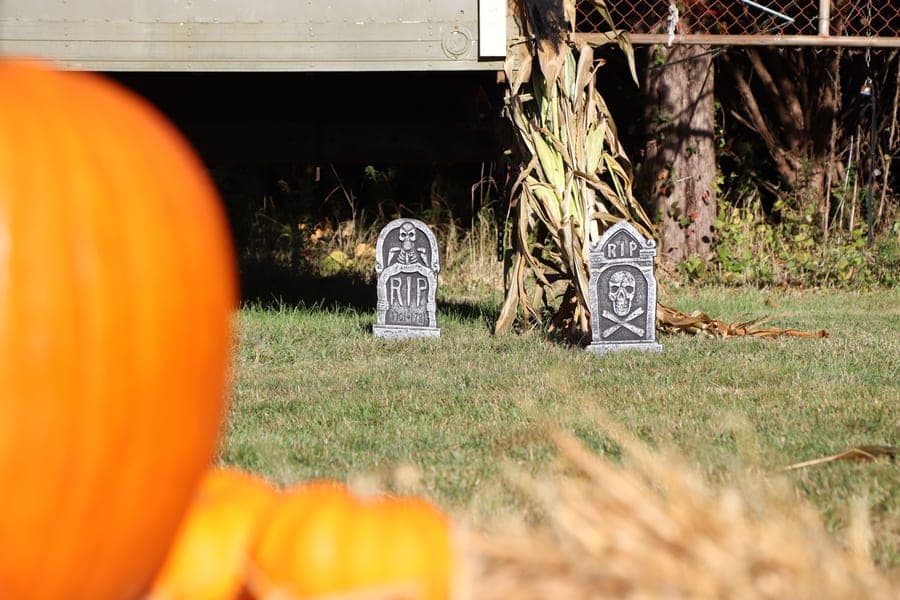
Foam weighs nothing and presents a flat face to the wind. That combination is why most graveyards are lying down by the second week of October.
Disclosure: we earn a commission from qualifying purchases made through links on this page, at no extra cost to you. It does not change what we recommend — here is how we choose.
The short answer
Secure a Halloween tombstone with at least two stakes per stone, driven at opposing angles so they cross under the foam rather than running parallel, and lean the stone three to five degrees backward into the prevailing wind. In wet ground, replace the supplied thin stakes with corkscrew anchors or lengths of rebar — the failure is almost never the stone, it is the stake sliding out of soft soil.
A graveyard is the highest-return scene in a yard haunt because it is cheap, it scales, and it reads instantly from the street. It is also the scene that most often needs rebuilding mid-month, and the reason is a straightforward physics mismatch: molded foam weighs almost nothing and presents a broad flat face to the wind, which is the worst possible combination for something held up by two wire pins.
Stake count beats stake quality
Before anything else: count what came in the box. A set of five stones with twelve stakes is a set designed to be secured properly. A set of five stones with five stakes is a set designed to photograph well. One stake per stone is a hinge, and a hinge in wind is a stone lying face down in the grass.
- Two stakes minimum per stone, set toward the outer edges of the base rather than the middle.
- Drive them at opposing angles, 15 to 20 degrees off vertical, so the two stakes converge underneath the foam. Parallel stakes let the stone rock between them; crossed stakes cannot.
- Three stakes for anything over about two feet tall, with the third at the center rear.
- Do not drive through the printed face. Use the molded channels if the stone has them, and go in from the back edge if it does not.
Buying a second pack of stakes is usually cheaper than buying a second set of stones, and it is always cheaper than walking the yard at midnight in the rain.
What to buy for this job
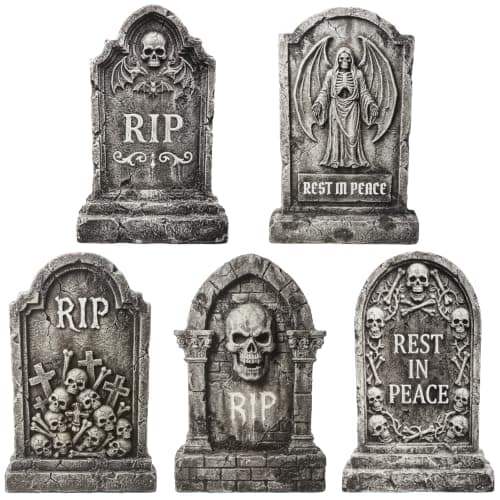
26" Extra Large Tombstones, 5 Pcs
JOYIN
Height is the single thing that decides whether a stone registers from a moving car, and this set is listed at 26 inches rather than the usual 17.
- Type
- Flat printed gravestone signs, 5 per set
- Height
- 26 in per stone (listed)
- Staking
- Metal stakes supplied
- Weather
- Listed as waterproof
Good
- Nine inches taller than the standard foam set, which is the difference between street-visible and not
- Listed as waterproof, so a wet week does not soften them the way foam swells
- Flat panels stack into nothing, which matters more than it sounds in a garage
Less good
- The listing states flat, not foam — there is no carved depth, so they look printed up close
- Flat panels catch wind like a sail; these need the stakes driven deep and angled
- Printed detail fades faster in direct sun than molded foam does
- Street presence8.4
- Build quality6.8
- Weather tolerance8.0
- Setup effort8.6
- Storage footprint9.4
#ad How we are funded - price as of November 4, 2026
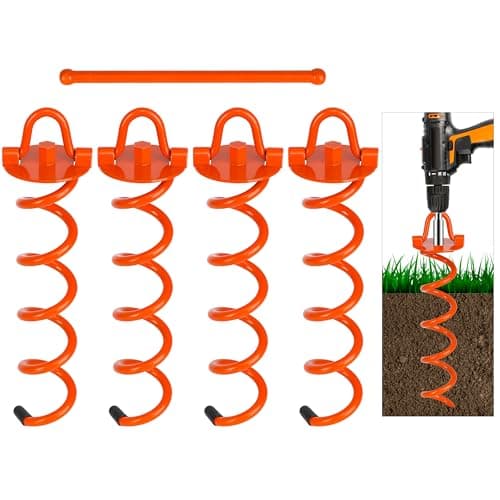
12 in Spiral Ground Anchors, 4 Pack
FEED GARDEN
The single highest-value upgrade in this whole category: the thin U-stakes in the box pull straight out of wet ground, and a corkscrew does not.
- Type
- Spiral or corkscrew ground anchor
- Common length
- 10 to 15 in
- Best ground
- Turf and soil, not gravel or hardstanding
- Installation
- Hand turned, no driving
Good
- Holds in saturated soil where a straight stake lifts
- Screws in by hand, so no mallet and no bent stakes
- Reusable season after season
Less good
- Useless on concrete, pavers or frozen ground, where you need weights instead
- Takes longer to install than driving a U-stake
- Leaves a visible plug hole in a manicured lawn
- Holding power9.2
- Ground versatility6.4
- Durability8.8
- Setup effort8.0
- Value9.0
#ad How we are funded - price as of November 4, 2026
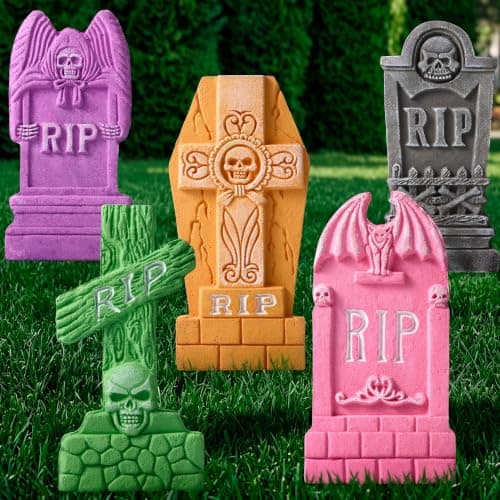
17" Foam RIP Graveyard Tombstones, 5 Pack
JOYIN
Molded foam with carved depth and twelve stakes for five stones, which is the ratio that decides whether a graveyard is still standing after the first windy night.
- Type
- Molded foam headstones, 5 per set
- Height
- 17 in per stone (listed)
- Staking
- 12 metal stakes supplied
- Power
- None
Good
- Carved relief reads as stone under a low light instead of flattening out
- More than two stakes per stone, so they can be cross-staked against wind
- Cheap enough to buy two sets and build density, which is what the look needs
Less good
- 17 inches is short — from a sidewalk these disappear into an unmown lawn
- Foam chips at the edges once it has been staked and pulled a few seasons
- Supplied stakes are thin wire; they bend in compacted or stony ground
- Street presence6.8
- Build quality7.6
- Weather tolerance7.4
- Setup effort9.2
- Storage footprint8.8
#ad How we are funded - price as of November 4, 2026
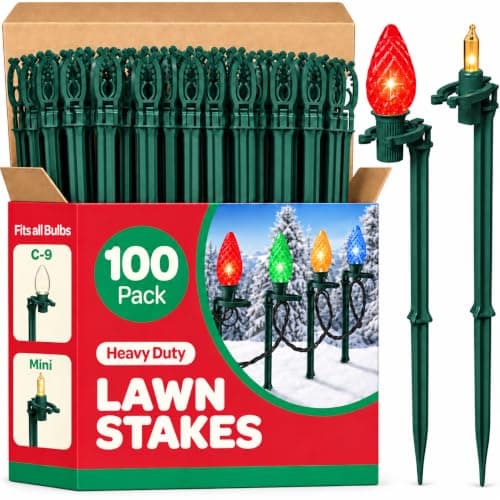
Outdoor Light Yard Stakes, Set of 100
Various
The unglamorous purchase that makes a display look professional. Cords pinned along a bed edge disappear; cords lying across a lawn do not.
- Type
- Ground stakes and clip hooks
- Use
- Pin cord along bed edges and fence lines
- Quantity
- Buy more than you think, one every few feet
- Season
- Reusable
Good
- Hides cord runs without burying anything
- Stops the mower and the leaf blower finding the cord
- Costs almost nothing per foot of tidy
Less good
- Plastic stakes snap in hard or frozen ground
- Not a substitute for a ramp where cord crosses a path
- You will lose half of them in the grass every year
- Safety value7.0
- Weather rating7.4
- Ease of use9.4
- Reliability7.0
- Value9.4
#ad How we are funded - price as of November 4, 2026
Lean the stone backward
This is the trick that costs nothing and changes the outcome. A tombstone set perfectly vertical has no margin: any gust past its tipping point puts it flat. The same stone tilted three to five degrees backward — away from the street, into the prevailing wind — has to be lifted through that angle before it can go anywhere, and the wind load on a slightly raked face is lower as well.
It also looks better. Real headstones settle and lean, and a graveyard of perfectly plumb stones at identical spacing reads as a row of signs. Vary the lean a degree or two either side, vary the spacing, and turn a couple of the stones a few degrees off square to the street.
Match the anchor to the ground
| Ground | What fails | What to use instead |
|---|---|---|
| Dry compacted soil | Nothing much | Supplied stakes are usually fine |
| Wet or saturated turf | Thin stakes slide straight out | Corkscrew anchors or rebar |
| Sandy soil | Stakes lose grip under load | Longer anchors, more of them |
| Mulch bed | Stake grips mulch, not soil | Push through to the soil beneath |
| Gravel | No purchase at all | Weighted base behind the stone |
| Concrete or pavers | Cannot stake at all | Sandbags behind, tether forward |
The wet-turf row is the one that catches people, because it is seasonal. A graveyard that has stood solidly for two dry weeks will come down on the first wet windy night, as the same stakes that held in firm ground start sliding in mud. Corkscrew anchors work here because soft soil has to shear around the spiral rather than slide along a pin.
Weight is the answer on hard surfaces
On a driveway, a patio or a path you cannot stake, the honest options are weight and tethers. A sandbag tucked behind the stone, out of sight from the street, holds a foam panel against anything short of a storm. Two bags per stone is better than one, because a single bag that slides has done nothing. If you can reach a fence or a rail, a short tether from the top rear of the stone takes the load out of the base entirely.
Buy the taller stones
One sizing note, because it affects everything above. The common 17-inch foam stone is below the height at which a stone registers from a moving car; a 26-inch stone does. Taller stones catch more wind and therefore need the anchoring on this page, which is the trade — but a securely anchored tall stone beats four short ones nobody can see. The best Halloween graveyard decorations ranks the sets, and building a Halloween graveyard scene covers the layout around them.
Protect the lawn while you are at it
Anchors go into turf and they come back out, and what is left behind is a month of shade and a hole. Pull every anchor the same week the display comes down, and move the stones a foot or two if you run the same scene in the same place next year. Keeping Halloween decorations from killing your grass has the full version, including the four-day rule for anything that covers the ground completely.
Frequently asked questions
How do you keep Halloween tombstones from falling over?
Two stakes per stone minimum, driven at opposing angles so they cross under the foam, and lean the stone three to five degrees backward into the wind. Parallel stakes let a stone rock itself loose; crossed stakes and a slight backward rake do not.
What is the best anchor for foam Halloween tombstones?
Corkscrew ground anchors in soft or wet ground, because the soil has to shear around the spiral rather than slide along a thin pin. Short capped lengths of rebar are the cheapest serious alternative. The thin wire stakes supplied in most sets are only adequate in firm dry soil.
How many stakes does a Halloween tombstone need?
At least two, and three for any stone over about two feet tall. Count the stakes in the box before you start: a five-stone set that ships five stakes is giving every stone a hinge instead of an anchor.
How do you secure tombstones on concrete or a driveway?
With weight and tethers, since you cannot stake. Put two sandbags behind each stone, out of sight from the street, and run a short tether from the top rear of the stone to a fence or rail if one is in reach so the load comes off the base.
Should Halloween tombstones be straight or leaning?
Leaning slightly backward, three to five degrees away from the street. It is more stable, because the wind has to lift the stone through that angle first, and it looks far better than a row of perfectly plumb stones at even spacing.
About the author
Mike M.
Mike M. is the hands-on owner behind Iron Mako Media, which publishes Haunt & Hedge. The site covers the gear that builds a yard haunt, for the person who already decorates and adds one bigger piece a year.
Every pick here is chosen from manufacturer specifications, manuals, safety standards and verified buyer data. Read how we choose picks.