Fog & Atmosphere
What Type of Fog Fluid Is Safe to Use?
There is an actual published standard for this, which is more than most of the internet will tell you. The short answer is water-based fluid from a brand that names its ingredients.

Disclosure: we earn a commission from qualifying purchases made through links on this page, at no extra cost to you. It does not change what we recommend — here is how we choose.
The short answer
Use a water-based fog fluid from a named brand that states its composition and the machine wattage it suits. Avoid oil-based haze fluid in a home, and never mix your own. There is a published standard for this — ANSI E1.5 — which defines the glycol and glycerin fogs considered unlikely to harm otherwise healthy people and sets exposure limits for them. Reputable theatrical fluid is made to that framework; a bottle with no ingredient list is not.
This question gets asked a lot and answered badly, usually in one of two unhelpful directions: either fog fluid is completely harmless and you can stand in it all night, or it is a mystery chemical you should keep away from children. Neither is right. What follows is what is actually established, what is genuinely unknown, and the handful of decisions that make a home display safe. We are not doctors and nothing here is medical advice — if anyone in your household has a respiratory condition, their clinician is the right person to ask.
What is actually in it
Standard theatrical fog fluid is mostly water. The rest is a glycol, a glycerin, or a blend of the two, and the machine works by pumping that mixture across a hot heater block so it flashes into a fine suspended mist. There is no combustion and no smoke: what you see is condensed droplets, which is why it is correctly called fog rather than smoke.
- Water-based glycol or glycerin fluid. The normal home and theatrical product. This is what every fluid on this site is.
- Oil-based haze fluid. A different product entirely, used for long-hanging atmospheric haze in professional venues. Not a home-display product.
- Dry ice / CO2. No fluid at all — solid carbon dioxide in water. Different hazards, covered below.
- Homemade mixtures. Not a category, a mistake. Covered below.
Brands differ in what they disclose, and disclosure is the signal worth buying on. Froggy's, for example, states that their Designer Select fluids are made from lab-grade UV-filtered deionized water and pharmaceutical-grade chemicals, all FDA approved, and that those fluids contain no glycerol or glycerin. That is a specific, checkable claim. A generic bottle with no ingredient statement and no stated machine range gives you nothing to evaluate, and that is reason enough to skip it.
There is a real standard: ANSI E1.5
This is the part most articles miss. The entertainment industry has a published American National Standard covering exactly this question. ANSI E1.5 describes the composition of theatrical fogs made with aqueous solutions of di- and trihydric alcohols — glycol and glycerin fogs — that are not likely to be harmful to otherwise healthy performers, technicians or audience members of normal working age.
Two things it does are worth knowing. It names which glycols may be used in a conforming fog, specifically to exclude irritating common industrial glycols and permit only those with ample public documentation of their benignity. And it sets both ceiling exposure limits and time-weighted-average limits, which means it treats dose over time as the thing that matters rather than just peak concentration.
The practical takeaway for a yard haunt is reassuring and also specific: the fluid category is well characterized and considered acceptable for healthy adults at controlled exposures, and the variable you control is dose. A few bursts across an evening in open air is nowhere near the situation the standard is written to bound. A machine running continuously in a closed garage for four hours is a different proposition.
Fluids that state what is in them
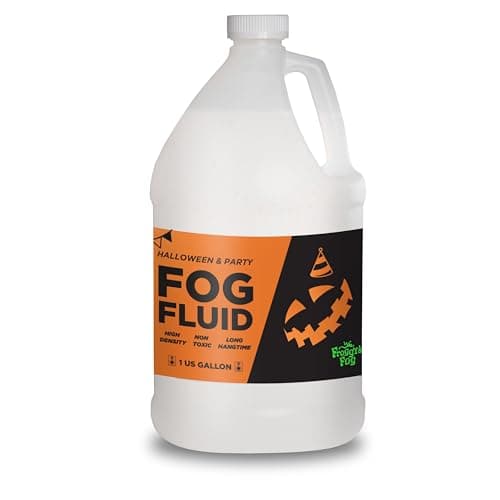
Halloween and Party Fog Fluid
Froggy's Fog
The everyday fluid for 400 to 1500 watt water-based machines, which is the right default when you are fogging a porch rather than engineering a graveyard creep.
- Type
- General-purpose fog fluid
- Machine range
- 400 to 1500 W water-based
- Output
- High output, long lasting
- Use
- Indoor and outdoor
Good
- Matches the wattage range most home machines actually sit in
- Cheaper per gallon than the specialist formulations
- Safe for the machines it is specified for, which protects the pump
Less good
- Shorter hang time than Swamp Juice outdoors
- Not chiller optimized
- General purpose means it is best at nothing in particular
- Hang time7.0
- Density8.0
- Machine safety9.0
- Outdoor suitability7.4
- Value8.8
#ad How we are funded - price as of November 4, 2026
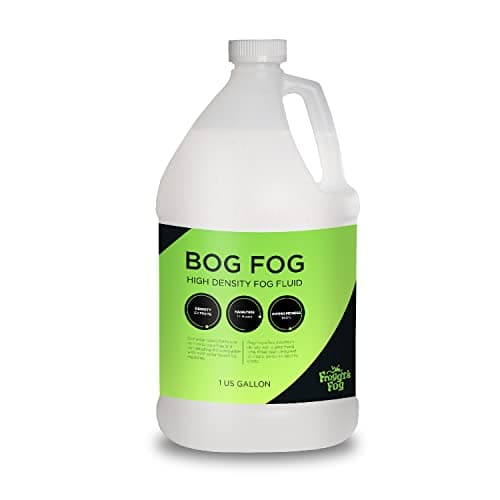
Bog Fog High-Density Fog Fluid, 1 Gallon
Froggy's Fog
Froggy's densest water-based fluid, sold for complete loss of visual reference. It is the right answer when you want a wall of fog and the wrong one when you want to see the props you bought.
- Type
- High-density (HDF) water-based fog fluid
- Machine range
- Any water-based machine, optimized for 700 W and up (manufacturer stated)
- Composition
- De-ionized water and pharmaceutical-grade chemicals; no glycerol or glycerin (manufacturer stated)
- Sizes
- 1 gal, 2.5 gal, 4 x 1 gal case, 5 gal pail, 55 gal drum
Good
- The densest water-based option Froggy's sells, with a slower stated evaporation rate
- Contains no glycerol or glycerin, which is the fraction people most often react to
- Stated to leave little to no residue, which matters on a porch or in a garage
Less good
- Density is easy to overdo — in a small space it reads as whiteout, not atmosphere
- Optimized for 700 W and up, so a 400 W party fogger is the wrong host for it
- It is not a low-lying fluid on its own; the ground creep comes from the machine
- Hang time8.4
- Density9.8
- Machine safety8.8
- Outdoor suitability8.6
- Value7.6
#ad How we are funded - price as of November 4, 2026
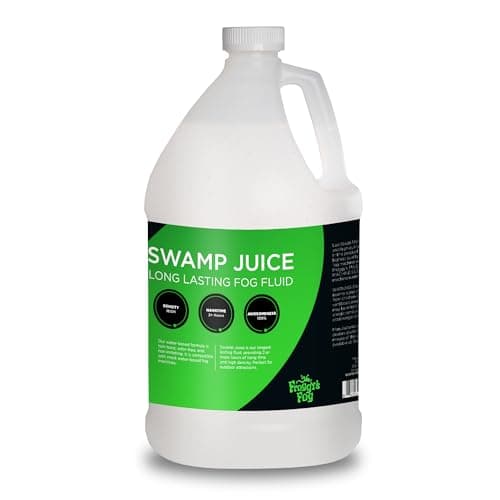
Swamp Juice Long-Lasting Fog Fluid, 1 Gallon
Froggy's Fog
Designed for outdoor use with a stated hang time of two to three hours, which is the difference between fog that is there when visitors arrive and fog that was there five minutes ago.
- Type
- Long-hang-time fog fluid
- Stated hang time
- 2 to 3 hours in favorable conditions
- Use
- Outdoor, water-based machines
- Recognition
- IAHA Vendor Excellence Award winner
Good
- Hang time is the whole point outdoors, and this is the fluid built for it
- Used by large commercial attractions, so it is proven at scale
- Works in standard water-based machines
Less good
- Long hang time also means haze that lingers where you did not want it
- Costs more per gallon than general-purpose fluid
- Hang time collapses in any real breeze, because no fluid fixes wind
- Hang time9.6
- Density9.0
- Machine safety8.6
- Outdoor suitability9.4
- Value7.2
#ad How we are funded - price as of November 4, 2026
Water-based, not oil-based, for a home
If you remember one distinction, make it this one. Water-based fluid produces fog that dissipates relatively quickly and leaves little residue. Oil-based haze fluid is designed to hang in the air for a long time in a controlled professional venue with ventilation planning behind it. It is not sold as a hazard, but it is the wrong tool for a house, a porch or a garage, and it will leave a film on surfaces that a water-based fluid will not.
| Where | Use | Avoid |
|---|---|---|
| Open yard | Water-based, any reputable fluid | Oil-based haze |
| Covered porch | Water-based, short bursts | Continuous running |
| Garage walk-through | Water-based, ventilate between groups | Running it with the door shut |
| Indoor room | Water-based, small machine | Yard-scale output |
| Near food | Nothing | Any fog over a buffet |
| Any space | A fluid that lists its contents | Unlabeled fluid, homemade mixes |
Water-based versus glycol fog fluid covers the chemistry in more depth, and which fog juice to buy ranks the specific fluids once you have settled the safety question.
Never mix your own
This is the one genuine mistake in the category, and it is common because the recipes are easy to find. Homemade fog juice — glycerin and water from a pharmacy, or anything involving oil — is a bad idea for two independent reasons, and the second is the one people forget.
- It damages the machine. Home mixtures do not match the viscosity and boiling behavior the heater block was designed around. The result is carbonized residue in the block, a clogged nozzle and a dead pump — which is the most common entry in fog machine troubleshooting.
- The output is uncharacterized. The whole basis for saying commercial fluid is acceptable is that its composition is known and documented against a standard. A mixture you made in a kitchen has no such documentation, whatever the source recipe claims. You are not reproducing a tested product, you are producing an untested one.
- It voids the warranty, and usually visibly, because residue in the heater block is easy to identify.
Commercial fluid is the cheapest consumable in this hobby. It is the last place improvising has any upside.
Who should be careful
The honest answer is that the standard is written around otherwise healthy people of normal working age, and that leaves categories it does not speak for. People with asthma or another respiratory condition are the clearest case: a dry throat, a cough or tightness in heavy fog is a commonly reported reaction, and someone who already has airway sensitivity is more likely to notice it. Glycerin is the fraction most often named in those reports, which is why a glycerin-free formulation is worth preferring if that applies in your household.
- Anyone with asthma or a respiratory condition should not be standing in fog, and their clinician is the right source on specifics — not us and not a forum.
- Small children are shorter, which puts them closer to where low-lying fog actually sits. Keep the fogged zone off the path to your door.
- Pets. Keep them out of the fogged area and indoors with a window cracked. There is less published guidance here than for people, which is itself a reason for caution rather than confidence.
- You, over four hours. The person most exposed on Halloween night is whoever is standing next to the machine. That is a dose question and it applies to you more than to any visitor.
The hazards that are not about chemistry
In practice the things most likely to go wrong on Halloween night have nothing to do with what is in the bottle.
- Smoke detectors. Fog droplets scatter light the same way smoke does, so optical detectors respond to them. Know where yours is before the first burst. Never disable one — reduce the fog instead.
- Visibility on a path. Fog across a walkway on the one night of the year your path is full of children carrying things is a trip hazard. Fog the scene, not the route — see where to put a fog machine.
- Slippery surfaces. Heavy fog settling on a tiled porch, decking or a smooth garage floor can leave it slick. It is worth checking by hand rather than assuming.
- The machine itself. A hot heater and an open fluid reservoir on a wet lawn is the real electrical risk in the yard — how to protect a fog machine from rain and yard haunt electrical safety cover it.
- Dry ice, if you go that route. Solid CO2 is a contact-burn risk and displaces oxygen in an enclosed space. It needs gloves, and it needs ventilation rather than a sealed room.
Handling and storing the fluid
Unglamorous and worth thirty seconds. Keep fluid sealed and out of reach of children and pets — it looks like a drink, and the bottles are often brightly colored. Keep it off its side in a garage where a cap can weep onto a shelf. Contamination rather than age is what ruins stored fluid, so a bottle that has been open and dusty all year is worth replacing rather than running.
At the end of the season, run plain fluid through the machine until the output is clear, drain the reservoir, and let it dry open before it goes in a box. That is a machine-longevity habit rather than a safety one, but it is the difference between a working fogger next October and the no-fog fault. Storing Halloween decorations covers the rest of the pack-down.
So what should you buy?
A water-based fluid from a brand that names its composition and states the machine wattage range it suits — and then match it to your machine rather than to the effect you want. A general-purpose fluid in the machine's stated band is the correct default for a porch or a modest yard. If anyone in the household is respiratory-sensitive, prefer a formulation that states it is glycerin-free. If you want ground creep, the purchase is a chiller rather than a different bottle, which low-lying fog juice versus regular explains in full.
And whichever fluid is in the tank, run it in short bursts as people arrive. That single habit halves the dose, halves the fluid cost, and genuinely looks better than a yard running at whiteout all evening. What size fog machine do I need covers sizing it correctly in the first place, and Bog Fog versus Swamp Juice covers the density-against-hang-time choice once safety is settled.
Frequently asked questions
What type of fog fluid is safe to use?
A water-based glycol or glycerin fluid from a named brand that states its composition and the machine wattage it suits. The published standard for this category is ANSI E1.5, which defines the glycol and glycerin fogs considered unlikely to harm otherwise healthy people and sets exposure limits. Avoid oil-based haze fluid in a home, and never mix your own.
Is fog machine fluid toxic?
Standard water-based theatrical fluid is mostly water plus a glycol or glycerin, and ANSI E1.5 characterizes conforming glycol and glycerin fogs as not likely to be harmful to otherwise healthy people at controlled exposures. Dose is the variable you control: a few bursts in open air is a very different situation from a machine running continuously in a closed garage.
Is fog fluid safe for kids and pets?
Keep both out of the fogged area. Children are shorter, which puts them closer to where low-lying fog actually sits, so keep the fogged zone off the path to your door. There is less published guidance for pets than for people, which is a reason for caution rather than confidence.
Can you make your own fog juice?
You should not. Home mixtures do not match the viscosity the heater block was designed for, which causes carbonized residue, a clogged nozzle and a dead pump. More importantly, the reason commercial fluid is considered acceptable is that its composition is documented against a standard — a kitchen mixture has no such documentation.
Will a fog machine set off a smoke alarm?
It can. Fog droplets scatter light the same way smoke does, so optical detectors respond to them. Outdoors it is rarely an issue; indoors or on a covered porch it is. Know where your detector is before the first burst, keep the output low and away from ceilings, and never disable an alarm — reduce the fog instead.
Does fog fluid leave a residue?
Water-based fluid leaves little, and some are specifically stated to leave little to no residue. Oil-based haze fluid does leave a film, which is one reason it is the wrong product for a house. Heavy fog settling on tile, decking or a smooth garage floor can still leave it slick, so it is worth checking by hand.
Sources
About the author
Mike M.
Mike M. is the hands-on owner behind Iron Mako Media, which publishes Haunt & Hedge. The site covers the gear that builds a yard haunt, for the person who already decorates and adds one bigger piece a year.
Every pick here is chosen from manufacturer specifications, manuals, safety standards and verified buyer data. Read how we choose picks.